

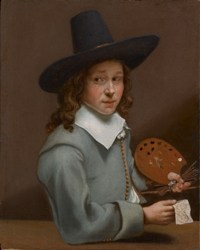
Biography
Aelbert Cuyp, one of the foremost Dutch landscape painters of the seventeenth century, was born in Dordrecht in October of 1620. His father, Jacob Gerritsz Cuyp (1594–1652), was a successful portrait painter in the city, and from him Aelbert received his earliest training, assisting his father by painting landscape backgrounds for portrait commissions. It is uncertain whether Cuyp had also apprenticed with a landscape painter, but he soon abandoned his father’s style and subject matter and turned almost exclusively to landscapes and riverscapes, painting only an occasional portrait in his mature period. Arnold Houbraken, a native of Dordrecht, noted that Cuyp was a man of “irreproachable character” (onbesproken leven), and the surviving documents concern his active involvement in the Dutch Reformed Church and the city affairs of Dordrecht, rather than his activities as a painter. His marriage to Cornelia Boschman (1617–1689), the wealthy widow of Johan van den Corput (1609–1650), a representative to the admiralty at Middelburg and a member of an important Dordrecht family, took place on July 30, 1658. After his marriage, Cuyp appears to have painted less frequently, probably owing to a combination of his increased church activity and the absence of financial pressures. He was buried in the Augustinian Church at Dordrecht on November 15, 1691.
Houbraken commented that only the artist’s own works were found in his home at the time of his death, proof that nature alone served as his model. The stylistic evolution of his oeuvre, however, disproves Houbraken’s conclusion. Cuyp’s early landscapes are clearly inspired by the compositional approach and monochromatic palette of
Cuyp seems to have worked for a number of important Dordrecht families. He was clearly an important artist in the city, although little is known about the organization or production of a workshop. Houbraken mentions only one pupil, Barent van Calraet (1649–1737), whose brother Abraham van Calraet (1642–1722), if not a pupil of Cuyp, was certainly a follower. It appears that many of Abraham van Calraet’s works were among those mistaken for autograph Cuyp paintings by the beginning of the twentieth century, when Hofstede de Groot included more than eight hundred entries in his catalogue raisonné of the master. By the late eighteenth century, Cuyp had many other followers and imitators, including Jacob van Strij (1756–1815).
Arthur K. Wheelock Jr.
April 24, 2014