


Shortly after buying a home in Astoria, Oregon, in 1997, photographer Robert Adams began paying attention to trucks rolling past, freshly loaded with timber from clearcut sites. “It was possible to see a line of three trucks, each carrying part of one tree. Now what you see,” he said in 2019, “are trucks carrying 30, 40, 50 spindly trees maybe a foot in diameter. The problem is: there’s a lot of evidence that it cannot continue.” According to the Oregon Wild advocacy group, more than 90 percent of the state’s old-growth forests—filled with trees anywhere from 100 to 1,000 years old—have been logged in the past 50 years, and “in the Willamette National Forest alone, there are 3,994 individual clearcuts today.”
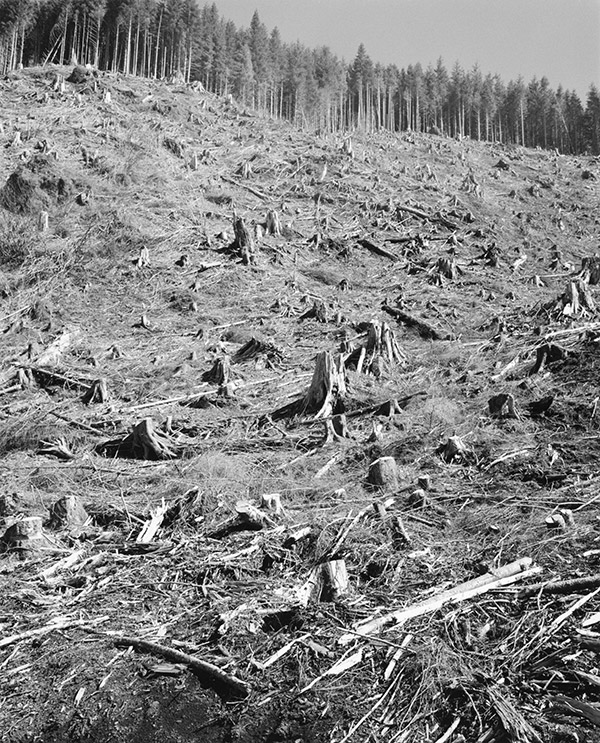
Robert Adams, Clearcut, Clatsop County, Oregon, c. 2000, gelatin silver print, San Francisco Museum of Modern Art, Gift of Daniel Greenberg and Susan Steinhauser, 2008.322
Angered by the short-sightedness of policymakers who allowed such destruction, and by the scarring of once pristine land, Adams set out to document the practice, creating a body of work called Turning Back (1999–2003). This was one of his most visceral projects, and he set some ground rules for it: “Not to use the sky [. . .] to rescue the land. Not to be seduced into celebrating the power of man and machines, which can have a Satanic beauty and heroism about it. And not to aestheticize the carnage.”
The results are, simply put, brutal. Vast hillsides—former forests—sheared to the ground, a tumble of unusable branches and boughs left behind. Gigantic stumps of once-towering trees left standing like tombstones. The violence to the land unspeakable.
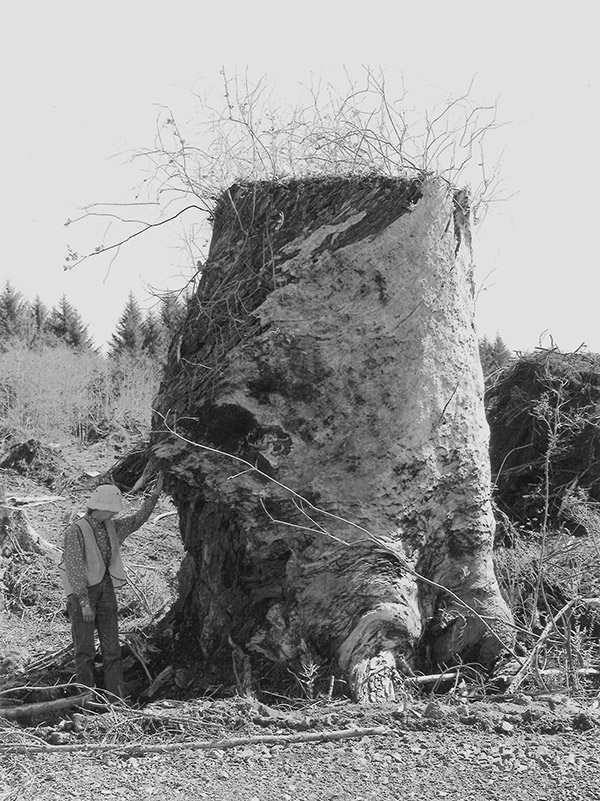
Robert Adams, Kerstin next to an Old-Growth Stump, Coos County, Oregon, 1999, gelatin silver print, San Francisco Museum of Modern Art, Gift of Daniel Greenberg and Susan Steinhauser, 2008.337
“Does clear-cutting originate in disrespect? It seems to us it clearly did,” he said in 2012, linking the pillaged lumber landscape to the terrains of war. “Does it, as a consequence, teach violence? Does it contribute to nihilism, of which we’ve got plenty in our society?”
The Role of Art in Change
Finding Hope in Poetry and Forests
Reshaping Ourselves
Robert Adams, The River’s Edge, 2015, gelatin silver print, Gift of Stephen G. Stein, 2020.29.3
But as so often with Adams’s works, there is space, light, and silence, which when combined he says “can be understood as sacraments.” He notes that every year, thousands make the drive to see the spit, and that “it’s a fair guess, I think, that many are looking to escape illusion and to be reconciled.”
Clearly, that’s one of the things the artist sought there. Adams has shared that he revels in the experience of nature with loved ones. (Most of his work is made in partnership with his wife, Kerstin.) But he’s also reaching out a hand to us, the viewers, to see it with him and, hopefully, be changed.
In his essay, “In the American West Is Hope Possible” (published in his 1989 book To Make It Home), he writes of the possibilities for cleaner air, better water conservation, and smarter land-use policies. But, “if most of the larger possibilities we have considered are beyond the span of our lives, for what is there hope within their span? If as individuals we can improve the geography only slightly, if at all, perhaps the more appropriately scaled subject for reshaping is ourselves.”
Just as Adams feels grounded and hopeful, if saddened, in nature, so can we.
“There are days that become, in the urgent and hushed sharing of a wonderful place with someone else, as much as I expect to know of the world for which I dream,” he writes.
“To hear one’s name, and the invitation, spoken with the assurance you will together see the same gift—‘look.’”
You can see American Silence: The Photographs of Robert Adams at the National Gallery through October 2.