The Wayback Machine - https://web.archive.org/web/20250312224510/https://www.nga.gov/collection/highlights/angelico-lippi-the-adoration-of-the-magi.html
Skip to Main Content
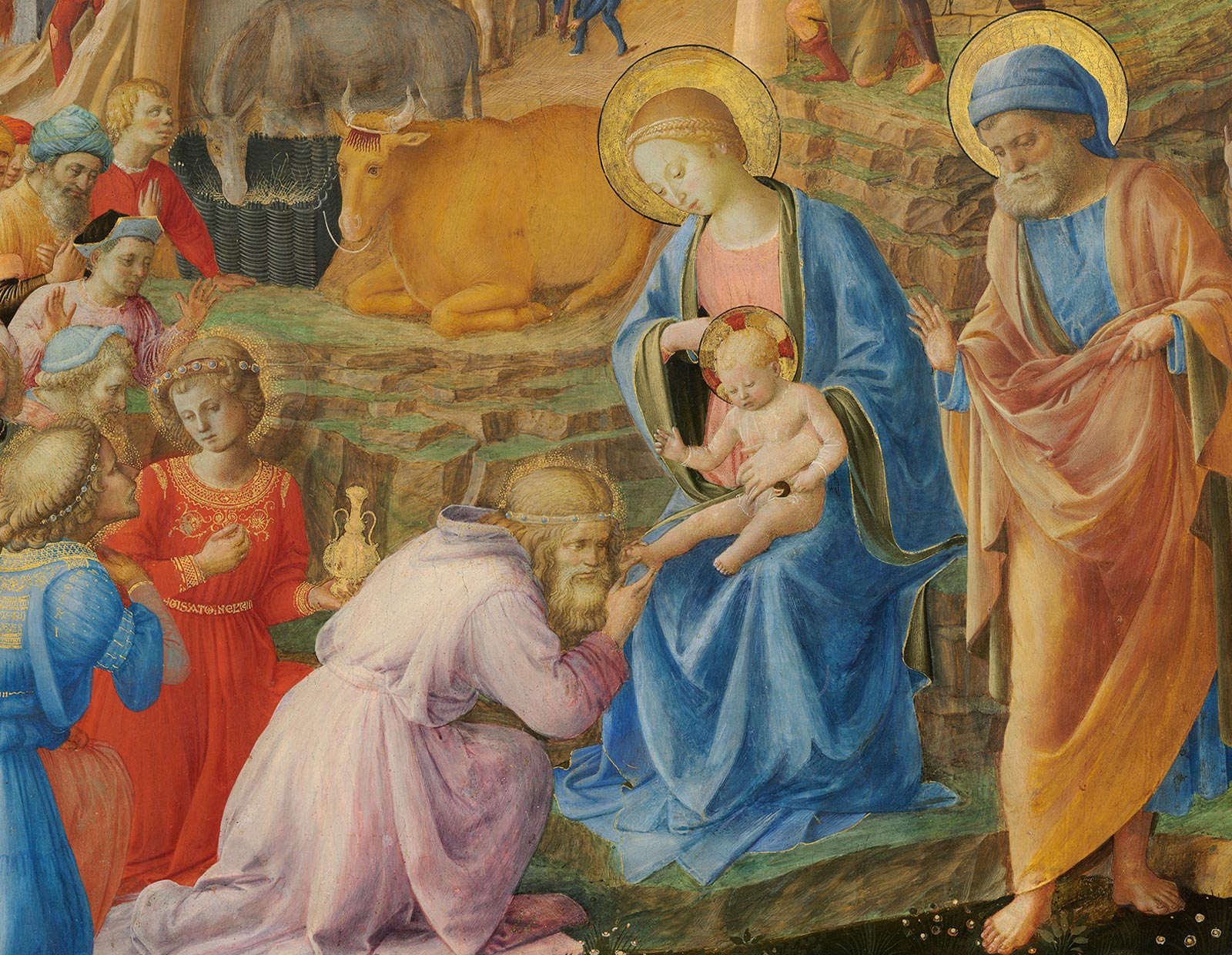
Fra Angelico, Fra Filippo Lippi, The Adoration of the Magi, c. 1440/1460

The Adoration of the Magi

Fra Angelico, Fra Filippo Lippi

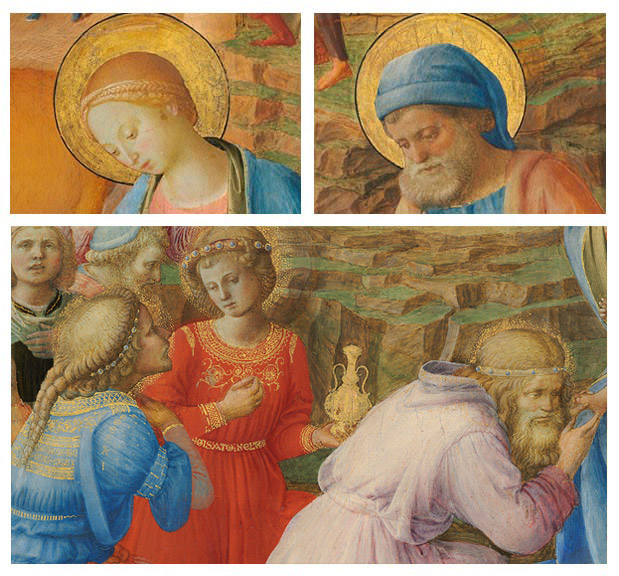
The Adoration of the Magi, c. 1440/1460 (details)

Top left: Detail of the Virgin; Top right: Detail of Joseph
Bottom: Detail of the Three Kings

The Gospel (Matthew 2:1-12) account of the arrival of wise men from the East to adore the new king of the Jews is quite brief. Not until the third century were they identified as kings and their number set at three. In Western tradition Melchior, Caspar, and Balthazar are kings of Persia, India, and Arabia, and represented as men of youth, middle age, and old age.

The Medici and the Magi

The Tondo

The tondo format appeared in Tuscany as early as the 1403s and was used well into the 16th century, primarily for images of the Virgin and Child. Probably, the form is linked to the desco da parto, a birth tray, typically round, that was given to celebrate births and was used to bring refreshment to new mothers—a natural fit for images of the Virgin and child and, even more, with the Adoration of the Magi. It is possible that the tondo shape is an innovation associated with the Medici; the first known tondo, also an Adoration of the Magi, was a Medici commission. And, although the tondo’s circular shape can be seen as generally symbolizing perfection and eternity, it might also relate to the Medici device of a diamond ring.

Image: Woodcut illustration and two round paintings

Left: Woodcut illustration from Savonarola, Predicta dell’arte del ben morire (Sermon on the Art of Dying Well), 1496
Chapin Library, Williams College, Williamstown, Mass.

Most tondos were apparently made for the home, as was this one depicted in the bedchamber of a dying man. The image illustrated a sermon on the subject of “dying well”—a preoccupation from the Middle Ages into the Renaissance—by Florence’s fiery preacher Girolamo Savonarola. Savonarola believed that images could reinforce faith and suggested the faithful should look on them daily and at the moment of their death. He wanted his sermon published with woodblocks to provide such images in an inexpensive form.

Right: Childbirth tray (desco da parto) with the Triumph of Fame (recto) and Medici and Tornabuoni arms and devices (verso), 1448–49
Giovanni di Ser Giovanni Guidi, called Lo Scheggia (Italian, Florentine, 1406–1486)
Tempera, silver, and gold on panel
Overall (with engaged frame)
Diam. 36 1/2 in. (92.7 cm); painted surface (recto)
Diam. 24 5/8 in. (62.5 cm); painted surface (verso)
Metropolitan Museum of Art, New York. Purchase in memory of Sir John Pope-Hennessy: Rogers Fund, The Annenberg Foundation, Drue Heinz Foundation, Annette de la Renta, Mr. and Mrs. Frank E. Richardson, and The Vincent Astor Foundation Gifts, Wrightsman and Gwynne Andrews Funds, special funds, and Gift of the children of Mrs. Harry Payne Whitney, Gift of Mr. and Mrs. Joshua Logan, and other gifts and bequests, by exchange, 1995 (1995.7)

This desco da parto was created to celebrate the birth of Lorenzo de’ Medici. The front bears a scene based on Petrarch’s I trifone (The Triumphs). In this case, the particular triumph illustrated—Fame—could hardly have been more prescient. On the reverse is the baby’s father’s device of a diamond ring with feathers, paired with the coats-of-arms of his mother Lucrezia Tornabuoni.

About the Artists

41581-barbadori-masterpiece

Filippo Lippi, Virgin and Child Surrounded by Angels with Saint Frediano and Saint Augustine, known as the Barbadori Altarpiece, 1437 (detail).
Oil on wood
208 x 244 cm.
INV. 339.
Photo: Jean-Gilles Berizzi.
Louvre, Paris, France
© RMN-Grand Palais / Art Resource, NY

The kneeling friar on the left who looks out of the painting is presumed to be a self-portrait.

Baptized as Guido di Piero, the artist we know today as Fra Angelico took the name Fra Giovanni when he entered the Dominican order some time between 1417 and 1425 at Fiesole, near Florence. It was not until the 19th century that he was routinely called Fra Angelico, from an early epithet, pictus angelicus (angelic painter). The description, it seems, was apt, for both his art and his character. Giorgio Vasari wrote of him in the 16th century: “It is impossible to bestow too much praise on this holy father, who was so humble and modest in all that he did and said and whose pictures were painted with such facility and piety.” The artist, who was offered but refused the position of Florence’s archbishop, was formally beatified in 1982 by Pope John Paul II.

Little is known of Fra Angelico’s early life, but it seems that he and his brother worked in a scriptorium, Fra Angelico as an illuminator, his brother as a scribe. Fra Angelico’s paintings on panel share the luminous color and delicacy of manuscript illustrations, and he continued to model forms with color and light rather than the shadows of chiaroscuro. His works have exceptional naturalism, and he employed perspective in innovative ways to create convincing architectural settings. Fra Angelico’s figures convey deep human sentiment that was a natural expression of his own piety. Although many of his greatest works were made for religious patrons, especially his own order, his plentiful clientele also included the Medici and other powerful Florentine families. By the 1430s he was running Florence’s largest and most sought-after workshop. He exerted a significant influence on other artists, including Filippo Lippi, before he was called by the pope in 1445 to work in Rome. He also completed commissions in Orvieto and Perugia, and served as the prior of the convent in Fiesole between 1450 and 1452. He died in Rome in 1455.

Filippo Lippi was born around 1406 in Florence, one of many children of an impoverished butcher. Orphaned at a very young age, he and a brother were sent to the Carmelite monastery; Filippo may have been as young as eight. In 1421, he took the vows of a Carmelite monk, entering a religious life for which he was wholly unsuited. Next to nothing is known about his training as an artist, but it must have been within the monastery. He apparently showed early talent: Giorgio Vassari, the 16th-century artist and biographer, reported that Filippo’s schoolmasters found him doodling instead of working at lessons, filling his notebooks and those of fellow students. During 1424 and 1425, he would have been in position to study firsthand a series of groundbreaking frescoes being completed in the Brancacci chapel of the Carmelite church. These innovative works by Masaccio and Masolino used strong, consistent light to model figures with shadow and give them robust three-dimensionality. They also put into practice Brunelleschi's theories about how to project depth beyond a flat painted surface. Filippo’s earliest paintings, from the late 1430s, share some of the austere monumentality of Masaccio’s work, but his style later became more ornate and linear.

Filippo was among the first Italian painters to be influenced by Netherlandish artists, whose paintings were brought south by Italian bankers and merchants with business in the north. Not only did Filippo respond to the Netherlandish artists’ highly detailed and realistic portrayal of surfaces—from crystal vases to richly brocaded fabric—he was the first Italian painter to adopt the northern practice of depicting the Virgin and Child in the domestic settings of contemporary life. Filippo was also among the earliest Italian painters to create independent portraits, perhaps, again, following models from the north. From the 1440s, his work was increasingly influenced by the more delicate and refined style of his contemporary Fra Angelico.

Related Works in the
National Gallery of Art Collection

Dozens of people form a line starting from an opening in a city wall or building in the background to a rustic shed-like structure close to us, to kneel before a seated woman holding a baby on her lap in this vertical painting. All of the people have pale skin tinged faintly with green. The top edge of the panel is shaped so it has two rounded sections like shoulders leading to a stepped, crown-like form with an inward curving triangle at the top. A nickel-gray, crenelated stone wall of a distant city is nestled into the top, stepped section, with a glimmering gold sky above filling the uppermost triangle. Tile-roofed and domed buildings and a few towers appear densely packed beyond the wall. People on foot and horseback create a line from an arched opening in the wall toward us and to our right. Three of the people on horseback in the distance wear long robes and have gold halos. The line of people winds behind a tall, narrow hill to our right and it continues close to us. Two horses, two camels, and several people wait to the right but our attention is drawn to the trio in the foreground, Mary, Jesus, and Joseph, and the three men near the infant, the Magi. Mary wears a lapis-blue mantle covering her head and shoulders over a petal-pink dress, and she sits on a wooden or stone chest in the center of the painting. Her body faces us but she turns her face to look with pale blue eyes off to our right. In one hand she holds a hexagonal gold vessel that tapers to a flame-like finial. With the other hand, on our left, she supports the blond infant sitting in her lap. He is covered only with a white cloth around his waist, and he looks toward the vessel as he holds up the index and middle fingers of his right hand. To our left and slightly behind Mary, a balding man with white hair and beard and wearing a blue garment under a red robe sits with his head propped in his hand, looking down. His other hand rests on what might be the handle of a crutch or staff. The man, woman, and child have gold halos with what appears to be writing. The three Magi also have gold halos and they all wear scarlet-red shoes. The oldest kneels before Mary and kisses Jesus's feet. He has a long, light gray beard and is balding. He wears a brocade-like gold robe over pale brick-red sleeves. A cleanshaven man with dark brown hair and wrinkles around his mouth kneels to our left as he raises a jewel-encrusted gold crown from his head. He wears a gold and red floral-patterned garment and holds a rounded vessel, also with a flame-like finial. A younger, cleanshaven man with smooth features and shoulder-length, curling blond hair to our right also wears a gold crown. A dagger hangs from the waist of his sky-blue tunic, and his leggings are pale plum purple. Both arms are bent to his hands are held up, and in his right hand, he holds another tabernacle-like gold vessel. The structure to our left houses a donkey and bull munching hay. A gold sunburst floats above the roof, which seems to be built up against the stone wall of a building. The hills and trees beyond the people is painted with pine and moss greens and brown.

Benvenuto di Giovanni, The Adoration of the Magi, c. 1470/1475, tempera on poplar panel, Andrew W. Mellon Collection, 1937.1.10

Three men with crowns and wearing gold-trimmed robes stand and kneel before a woman sitting on a wooden, box-like seat holding a baby to our right, in front of a rocky cave and landscape, in this horizontal painting. A balding man with a gray beard and hair, Joseph, and two younger people with blond hair stand around the woman, Mary, to our right, while a group of five young men or boys and three horses gather near the left edge. All the people have pale skin. Mary, the baby Jesus, Joseph, and the three men closest to them all have shimmering gold halos. One balding man with a long white beard kneels and kisses the baby’s feet. He wears a gold and crimson-red brocade-like robe over a burgundy-red garment, and he holds a pointed gold crown in his right hand, which rests on the ground. Behind him and to our left, a younger man with curly blond hair and goatee, wearing a wine-red tunic belted with gold and a gold crown on his head, holds his hands in prayer as he kneels down on one knee. The third stands to our left, cleanshaven with long blond hair. He wears a fur-lined, thigh-length scarlet-red robe and a gold crown, and he holds up a gold vessel in one hand. To our right, Mary wears a lapis-blue robe that covers her head and falls to her feet. The baby is covered only by a white cloth across his hips, and he has short blond hair. He touches the kneeling man’s head with one hand. His body is pudgy but his face has more adult-like, delicate features. Joseph stands at the woman’s far shoulder, wearing a butter-yellow robe over a rose-pink garment. His hands are gathered on a walking stick in front of his chest and his brows are furrowed with deep lines. One of the two younger people behind Mary, to our right, holds a lidded gold vessel. The group of five attendants to our left gather around cream-white, gray, or chestnut-brown horses. These blond people wear garments of dark olive-green, coral-red, royal-blue, or rose-pink tunics over black stockings. The rocky, brown cave behind Mary and Jesus, to our right of center, is occupied by a donkey and an ox behind a wooden trough. The landscape beyond is segmented into quilt-like squares of stylized crops. The horizon line comes almost to the top edge of the panel beneath a narrow strip of vivid, cobalt-blue sky. A gold star like a sunburst with rays of light hovers over the woman and child.

Giovanni di Paolo, The Adoration of the Magi, c. 1450, tempera on panel, Andrew W. Mellon Collection, 1937.1.13

Explore all Collection Highlights