

About the Artists
Giovanni Bellini was probably born in Venice around 1430. Part of an illustrious family of artists that included his father Jacopo, brother Gentile, and brother-in-law Andrea Mantegna, he was among the first artists in Italy to master the new techniques of painting with oils, producing the luminous color that would characterize Venetian art for centuries to come. He fully absorbed the Renaissance innovations made by artists in Florence and remained open to new influences during his long career. Bellini was also a generous teacher—his pupils included Giorgione and Titian.
Early in his career he devoted himself—and his busy workshop—to the production of religious paintings, including large altarpieces and smaller devotional images, especially images of the Virgin and Child, whose iconlike serenity and dignity drew on Venice’s Byzantine tradition. Throughout his life religious paintings continued to make up the largest part of Bellini’s output. All of his religious figures—as well as the sensitively painted landscapes they inhabit—are suffused with light and imbued with a spiritual presence.
Bellini was also a prolific portraitist, particularly during the 1480s and 1490s, helping to popularize a genre that was virtually unknown until the 1470s. Most of Bellini’s portrait subjects exhibit a reserved and somewhat generalized appearance, more reflective of their dignity and status than of personality. He worked for Venice’s patricians as well as for wealthy merchants and their religious confraternities. He also received major public commissions from the Venetian Republic. Despite pressures from powerful patrons for works celebrating themes from antiquity, Bellini resisted painting mythological subjects until late in life. When he did, he approached their unfamiliar erotic elements—not a natural fit for his more formal style—directly and with humor, taking cues from younger painters.
In a career that spanned more than 70 years, Tiziano Vecellio, called Titian in English, was the greatest force in Venetian Renaissance painting. Probably born around 1490 in the town of Cadore in the Italian Alps, Titian moved at an early age—perhaps as young eight or nine years old—to Venice to study art there. After training briefly with a mosaicist, he entered the workshop of Giovanni Bellini, the leading painter of his generation. Titian was influenced not only by Bellini’s rich color but by the lyrically elusive pastoral and mythological scenes of fellow Bellini pupil Giorgione.
By 1510 Titian had established himself as an independent master, and after Bellini’s death he was appointed official painter to the Venetian Republic. Following a succession of commissions for the courts of Ferrara, Mantua, and Urbino, Titian’s fame spread internationally. His patrons included the Holy Roman Emperor Charles V, Philip II of Spain, Francis I of France, and Pope Paul III.
Related Resources
Artist Information
NGA Images
Download a digital image of this work
Slideshows
The Feast of the Gods
Titian and the Late Renaissance in Venice
Giorgione and the High Renaissance in Venice
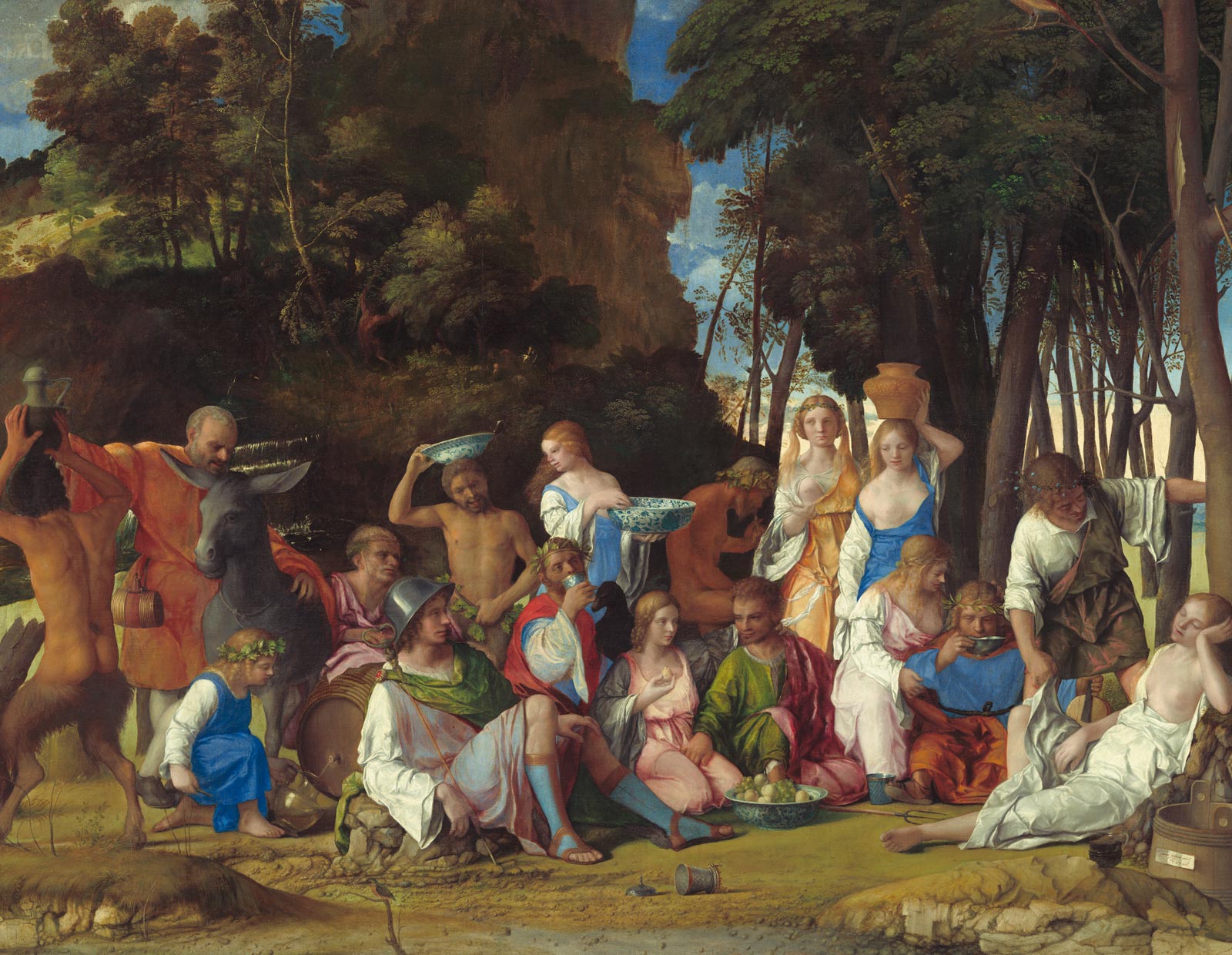
Giovanni Bellini and Titian, The Feast of the Gods, 1514/1529, oil on canvas, Widener Collection, 1942.9.1
Titian was a master in all genres: he produced dignified and insightful portraits, Madonnas of modesty and charm, playfully joyous mythological pictures, sensuous nudes, and meditative religious works. He took from Bellini a typically Venetian approach to color, his early works often juxtaposing brilliant contrasting hues. After about 1530, the year of his wife’s death, Titian more often worked within a more narrow tonal range, using subtle glazes to create complex nuances of color. During the last 20 years of his life, Titian's handling of paint grew looser, opening up a wider gamut of expressive possiblities. Thin glazes appear along with heavy impasto, each a mark of the artist’s own presence on the canvas.
Titian died in 1576, as an outbreak of the plague roiled through Venice, but it is not known if he died of the disease. He was buried in Santa Maria Glorisa dei Frari, where his dramatic altarpiece, The Assumption of the Virgin, had been installed nearly 60 years before.
Explore all Collection Highlights