
 Formed in 2009, the Archive Team (not to be confused with the archive.org Archive-It Team) is a rogue archivist collective dedicated to saving copies of rapidly dying or deleted websites for the sake of history and digital heritage. The group is 100% composed of volunteers and interested parties, and has expanded into a large amount of related projects for saving online and digital history.

.jpg)
Cézanne was born in Aix-en-Provence, where his father, originally a hat maker, had become part owner of a bank. Cézanne received a strong classical education and shared his adolescence with Émile Zola, future novelist and critic. At his father’s insistence, Cézanne studied law but was increasingly drawn to art. In 1861 he went to Paris.

Georges Braque, Harbor, 1909, oil on canvas, Gift of Victoria Nebeker Coberly in memory of her son, John W. Mudd, 1992.3.1
.jpg)
Kees van Dongen, Saida, 1913 or 1920, oil on canvas, Collection of Mr. and Mrs. John Hay Whitney, 1998.74.2
Yet it would be a mistake to view this painting only in terms of what comes next.
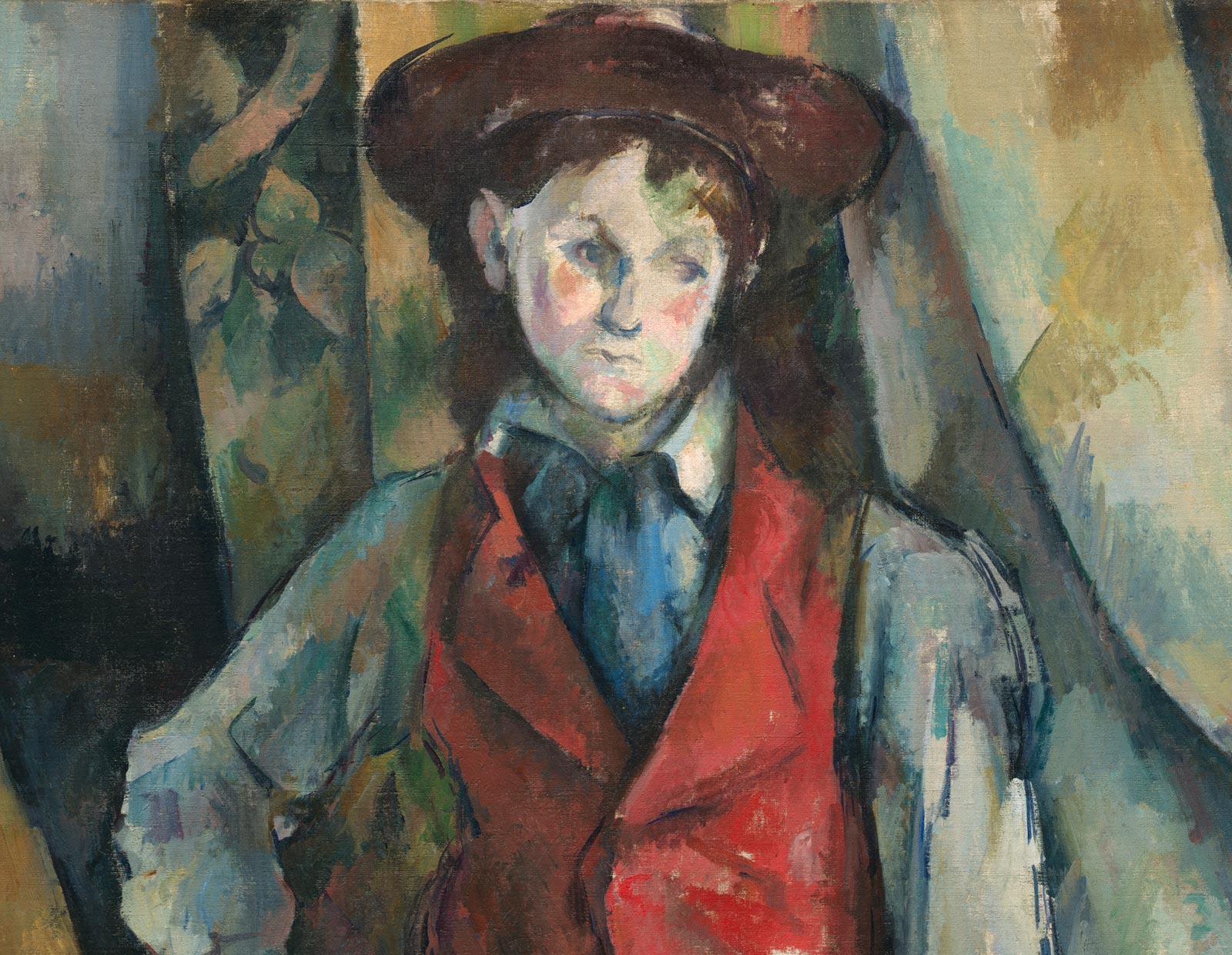
Cézanne’s orchestrations of pattern and color, despite their astonishingly modern look, did not originate as an exercise in form and abstraction. Instead, they grew out of the artist’s response to his subject. He was, he said, seeking to realize a "harmony parallel to nature." Throughout his life Cézanne stressed that he painted from nature and according to his sensations. It was through color relationships that he made visible the fundamental character and connectedness of what he saw and felt. In the boy’s face and shirt the tones are mostly cool and remarkably varied—pinks, greens, lavenders, blues, purples—a contrast to the reds of his vest. Elsewhere color is more subdued. Autumnal tones in the background, some warmer, some cooler, all lower keyed, function like a moody bass line, tempering the more brilliant accents that play out over them.
The boy, a professional model named Michelangelo di Rosa, is garbed in the romantic costume of an Italian peasant, with floppy tie to match his striking vest. The round-brimmed hat, positioned high on his head gives him a certain naiveté, and the mussed bangs make him seem young, even vulnerable. He appears pale and pensive, his small mouth formed faintly, in Shapiro’s words, like the wings of a distant bird. Cézanne painted di Rosa several times while he was in Paris between 1888 and 1900. He must have found the young Italian an appealing subject, since he usually posed family members and friends.
.jpg)
Florentine 16th Century, Ugolino Martelli, mid 16th century, oil on panel, Samuel H. Kress Collection, 1939.1.79
.jpg)
Pontormo, Monsignor della Casa, probably 1541/1544, oil on panel, Samuel H. Kress Collection, 1961.9.83
About the Artist
Related Resources
Online Feature
A Selection of Portraits from Cézanne’s Sketchbook
Slideshow
The Fauves
Image Download
Download a digital image of this work
.jpg)
Paul Cezanne, Boy in a Red Waistcoat, 1888-1890, oil on canvas, Collection of Mr. and Mrs. Paul Mellon, in Honor of the 50th Anniversary of the National Gallery of Art, 1995.47.5
Cézanne’s early works were dark and heavy. He applied pigments with emphatic brushstrokes or a palette knife, and his subjects were “difficult,” sometimes violent and erotic, deeply personal. In the early 1870s, under the influence of the impressionists, Cézanne’s style changed. Working alongside his mentor Camille Pissarro, he turned to landscapes and adopted the impressionists' broken brushwork and brighter colors. He exhibited with them in 1874 and 1877 (his submissions provoking some of the most stinging ridicule). Cézanne’s paintings did not sell; in fact, they were seen by few except fellow painters. As he grew disillusioned, he divided his time between Provence and the capital. After his father’s death in 1886, Cézanne moved permanently to Provence (though he kept a studio in Paris and made extensive visits there).
Related Works
.jpg)
.jpg)
Explore all Collection Highlights