
 Formed in 2009, the Archive Team (not to be confused with the archive.org Archive-It Team) is a rogue archivist collective dedicated to saving copies of rapidly dying or deleted websites for the sake of history and digital heritage. The group is 100% composed of volunteers and interested parties, and has expanded into a large amount of related projects for saving online and digital history.

About the Artist
Thomas Cole, considered the founder of the Hudson River School of American landscape painters, was born on February 1, 1801, in Bolton-le-Moor, England. Before emigrating with his family to the United States in 1818, he served as an engraver's assistant and as an apprentice to a calico print designer. While living in Steubenville, Ohio, Cole learned the basics of oil painting from an itinerant portrait painter. In 1823 he began experimenting with drawing from nature, creating detailed and expressive images of trees and branches. Later that year he moved to Philadelphia to study at the Pennsylvania Academy of the Fine Arts.
In April 1825 Cole moved to New York City, and shortly thereafter began making extensive sketching trips up the Hudson River and into the Catskill Mountains. In late October 1825, three of his landscapes were purchased by prominent figures in the young nation's art community: John Trumbull (1756–1843), William Dunlap (1766–1839), and Asher B. Durand (1796–1886).
Cole had numerous commissions in the late 1820s to paint his famed views of American landscapes. But with his ambition to paint a “higher style of landscape” to communicate his beliefs and values, Cole began painting large allegorical works, such as the five-canvas series Course of Empire (New-York Historical Society). During this period, William Dunlap’s 1834 A History of the Rise and Progress of the Arts of Design in the United States pronounced Cole “one of the finest painters in landscape...that the world possesses.”
Cole continued to paint American landscapes in the 1830s and 1840s, but much of his energy was focused on creating complex imaginary works, including Departure and Return (1837, Corcoran Gallery of Art, Washington, D.C.) and The Voyage of Life (1839–1840, Munson-Williams-Proctor Art Institute, Utica, and 1842, National Gallery of Art, Washington, D.C.).
Related Resources
Artist Information
Image Download
Download a digital image of this work
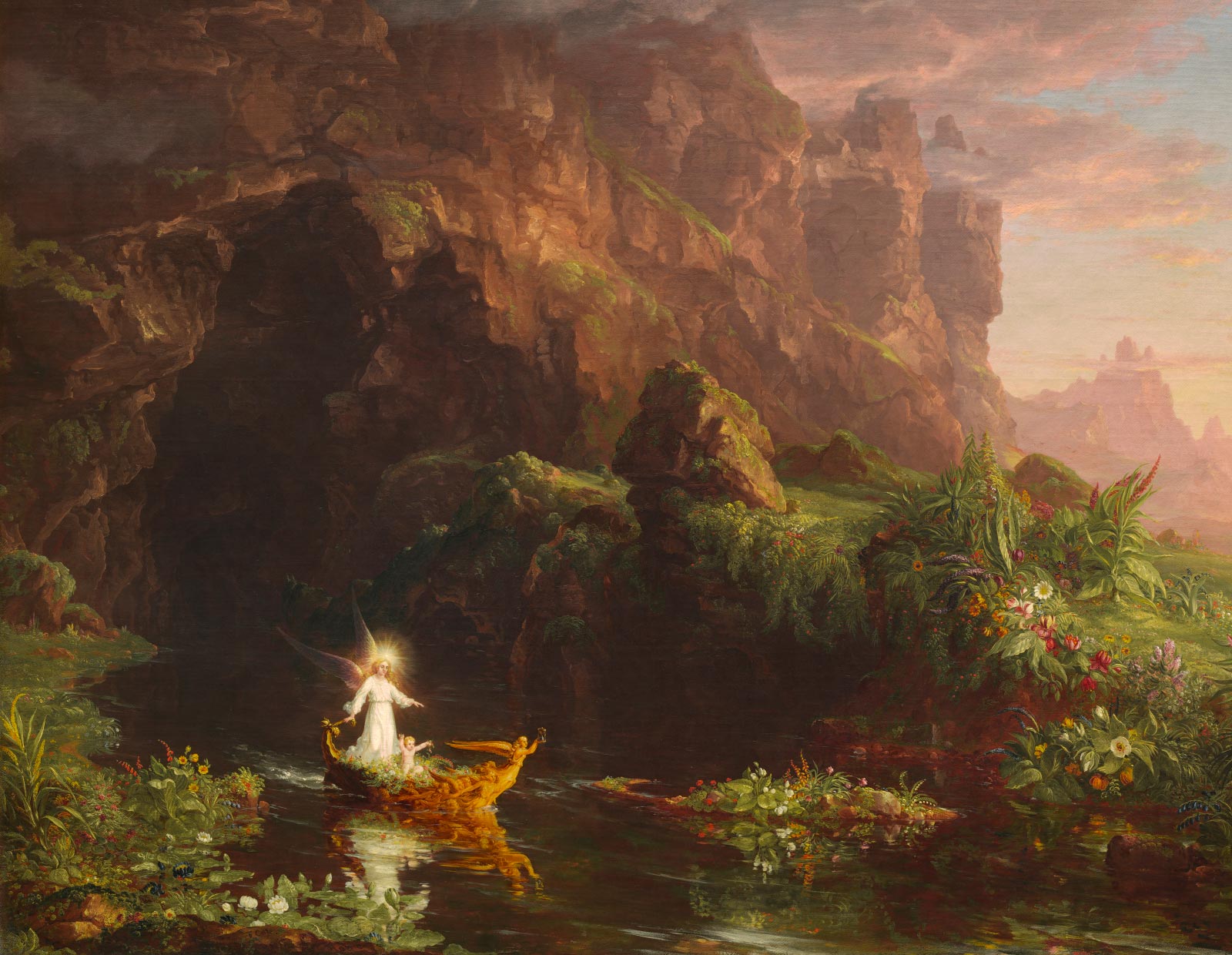
Thomas Cole, The Voyage of Life: Childhood, 1842, oil on canvas, Ailsa Mellon Bruce Fund, 1971.16.1
Cole actually painted two versions of the Voyage of Life. After the first set was restricted from public view by the owners, Cole painted a duplicate set, which he exhibited from 1843–1844 in New York, Boston, Philadelphia, and other cities. The second set, owned by the National Gallery of Art, received much acclaim after James Smillie produced and distributed engravings of the series.
Following Cole’s death in 1848 at age 47, a comprehensive memorial exhibition of his works was held at the American Art-Union in New York. Close to 500,000 people (equivalent to half the population of New York City at the time) came to see the exhibition. Cole’s influence on the course of American landscape painting was profound and his works influenced numerous younger painters who matured in the late 1840s and early 1850s, most notably Jasper F. Cropsey and Frederic Edwin Church.
Explore all Collection Highlights