
The Wayback Machine - https://web.archive.org/web/20250304042659/https://www.nga.gov/collection/highlights/constable-wivenhoe-park-essex.html
Skip to Main Content

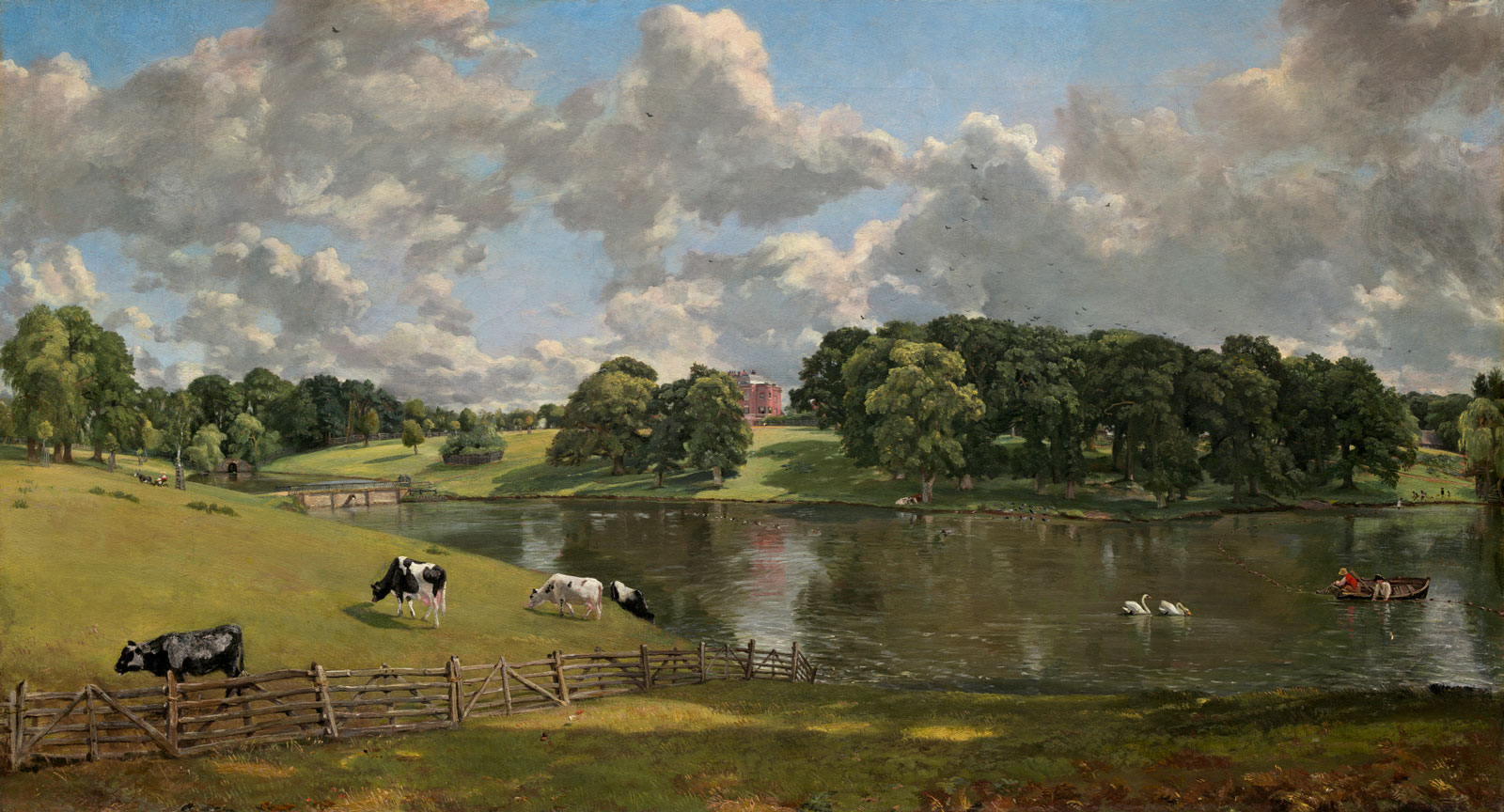
Wivenhoe Park, Essex

JOHN CONSTABLE

John Constable, Fishing with a Net on Lake Wivenhoe Park, 1888, V&A Images/Victoria and Albert Museum

John Constable, Fishing with a Net on Lake Wivenhoe Park, 1888. V&A Images/Victoria and Albert Museum.

Wivenhoe Park, located about 55 miles northeast of London, was the seat of the Rebow family. Major-General Rebow, a friend of Constable’s father, commissioned the artist to capture the beauty of his estate, inviting him to spend some weeks on the premises. General Rebow specified that certain features be included in the painting. Constable arranged these harmoniously, modifying the actual location of certain elements (for example, the house and lake were not actually part of the same view). Typically, the owner of such a house might wish for a more grandiose portrait of it, but Constable preferred the everyday poetry of landscape and sky.

The painting was a important project for Constable on a personal level: He needed the income the commission generated in order to provide for his longtime love, Maria Bicknell, and enable them to marry with the approval of her parents, who opposed the match for a number of years. Wivenhoe Park, Essex was finished by September 1816, and Bicknell and Constable were at last married on October 2, 1816.

About the Artist

John Constable, Self-Portrait,

John Constable, Self-Portrait, 1806. Tate, London / Art Resource, NY.

John Constable did not come from a family of artists; rather, his interest grew gradually under the tutelage of local painters and connoisseurs he befriended. His father was a flour miller in East Bergholt, Suffolk, a profession he expected his son to assume. John joined the family business after completing school, but in 1799, around age 23, was able to convince his skeptical father to allow him to pursue artistic training. Supported by an allowance, he enrolled at London’s Royal Academy of Art, the foremost institution for arts education and for exhibition of work by accomplished artists. Constable studied the naturalistic landscapes of 17th-century Dutch artists and the classically infused ones by French artist Claude Lorrain.

The artist always saw his calling in landscape painting, which derived from his love of nature and the hills of his native Suffolk. He wrote, “Those scenes made me a painter, and I am grateful: that is, I had often thought of pictures of them before I ever touched a pencil.”

We look across an expanse of a flat, grassy lawn at the towering spire of a stone church outlined against billowing clouds in this horizontal landscape painting. The lawn is dappled with light filtering through a line of trees with thick, green canopies to our left. The trees take up almost the left half of the composition, and they line a dirt path where three people walk. Tiny in scale, the people are painted with strokes of slate blue, red, white, and black. A few animals, perhaps cows, graze on the lawn near more trees on the far side of the green. Beyond the trees, the church sits on the horizon, which comes about a quarter of the way up the composition. Miniscule touches of yellow, black, and red may suggest more people in the deep distance. The pale blue sky is nearly filled with puffy parchment-white and mauve-tinged clouds.

John Constable, Salisbury Cathedral from Lower Marsh Close, 1820, oil on canvas, Andrew W. Mellon Collection, 1937.1.108

His initial efforts were not met with great acclaim, and he struggled for a decade, taking up more lucrative portrait painting commissions to augment the allowance from his family. Nonetheless, Constable remained focused on scenes of a domesticated landscape imbued with “human associations” rather than the dramatic vistas or sentimental or narrative scenes in favor with the Academy. Ambitious and determined, he honed his craft in the countryside around his family’s home and in places such as Salisbury in the southwest, where he stayed with a friend and frequently painted its cathedral (an example of which is also in the collection).

John ConstableMaria Constable with two of her Children, c. 1820. Tate, London / Art Resource, NY.

More Works by John Constable in the Collection

We look across an expanse of a flat, grassy lawn at the towering spire of a stone church outlined against billowing clouds in this horizontal landscape painting. The lawn is dappled with light filtering through a line of trees with thick, green canopies to our left. The trees take up almost the left half of the composition, and they line a dirt path where three people walk. Tiny in scale, the people are painted with strokes of slate blue, red, white, and black. A few animals, perhaps cows, graze on the lawn near more trees on the far side of the green. Beyond the trees, the church sits on the horizon, which comes about a quarter of the way up the composition. Miniscule touches of yellow, black, and red may suggest more people in the deep distance. The pale blue sky is nearly filled with puffy parchment-white and mauve-tinged clouds.

John Constable, Salisbury Cathedral from Lower Marsh Close, 1820, oil on canvas, Andrew W. Mellon Collection, 1937.1.108

This horizontal painting is filled with gray and white clouds against a blue sky. Wisps of white clouds are interspersed among banks of darker gray clouds against a pale blue sky in the top half of the painting. A tower of gray clouds to the left obscure a deep red circle, which only becomes evident upon careful inspection. Rays of pale shell pink streak down from the clouds along the bottom edge of the painting.

John Constable, Cloud Study: Stormy Sunset, 1821-1822, oil on paper on canvas, Gift of Louise Mellon in honor of Mr. and Mrs. Paul Mellon, 1998.20.1

From a grassy riverbank, we look across the placid surface of a river lined along the far bank with trees and farm animals in this horizontal landscape painting. The scene is painted loosely with brushstrokes visible throughout, so some details are difficult to make out. For the surface of the river, russet-brown and steel-gray paint skims lightly across the canvas and leaves some unpainted areas visible, creating the effect of light shimmering on the still water. On our left, a shallow wooden barge is propelled along the stream by two men in red caps with long poles. The boat carries a white horse wearing blinders and a harness. The riverbank beyond is lined with pale, sage-green grass tinged with gold, growing in front of a tangle of darker green trees and bushes. Across the water from us near the middle of the picture, a small rowboat sits in the shallows at the foot of a steep riverbank. Above, a white cottage with a reddish roof and chimney is tucked behind the trees, with a wooden rack full of hay next to it. Nearby, a plow and wheeled cart, highlighted with strokes of white, sit near more mounds of hay. Rocky fields reach into the distance. The vista is blocked to our right by another clump of trees and a rocky outcropping, rising from the stream, to our right of center. The steep, dark roof of a farmhouse is barely visible among the trees. Along the riverside to our right, a small group of cinnamon-brown and cream-white cows stand at water's edge. A rolling pasture stretches behind them to meet blue hills in the distance. Above, in the upper third of the painting, mottled white, pale rose, and gray clouds rolling across a steel-gray sky are reflected in the water below.

John Constable, The White Horse, 1818-1819, oil on canvas, Widener Collection, 1942.9.9

Explore all Collection Highlights