
The Wayback Machine - https://web.archive.org/web/20250428171957/https://www.nga.gov/collection/highlights/durer-melencolia.html
Skip to Main Content

Melencolia I

Albrecht Dürer

Dürer's Master Engravings

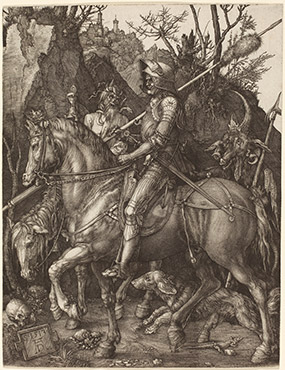
In 1513–1514 Dürer produced three exceptional copper engravings—Knight, Death and Devil, Saint Jerome in His Study, and Melencolia I—that have come to be known collectively as the Meisterstiche, or Master Engravings. Some scholars have interpreted the master engravings as complementary examples of different virtues—moral (the Knight), theological (Saint Jerome), and intellectual (Melencolia). Saint Jerome and Melencolia may be informal pendants; Saint Jerome’s clarity, light, and order contrast markedly with Melencolia’s brooding angst, nocturnal setting, and disorderly arrangement. Though it is not certain that Dürer conceived of the three prints as a set, they are similar in style, size, and complexity, and represent the pinnacle of Dürer’s practice as an engraver. Unlike many of his other prints, these engravings, large by Dürer’s standards, were intended more for connoisseurs and collectors than for popular devotion. Their technical virtuosity, intellectual scope, and psychological depth were unmatched by earlier printed work.

Albrecht Dürer, Knight, Death, and Devil, 1513, engraving on laid paper, 1941.1.20

Albrecht Dürer, Saint Jerome in His Study, 1514, engraving on laid paper, 1949.1.11

Albrecht Dürer, Melencolia I, 1514, engraving, 1949.1.17

About the Artist

Albrecht Dürer, Self-portrait with gloves at age 26

Albrecht Dürer, Self-portrait with gloves at age 26, 1498, Museo del Prado, Madrid, Spain, Photo Credit: Scala / Art Resource, NY

Albrecht Dürer (1471–1528), one of the greatest of all German artists, was a painter, printmaker, draftsman, and theoretician. He is largely credited with bringing the Italian Renaissance to northern Europe, and he revolutionized printmaking, elevating it to an independent art form.

Born in Nuremberg, Dürer apprenticed first with his father, a goldsmith, and then with Michael Wolgemut, the leading painter and woodcut artist in the city. He worked in Basel and Strasbourg as a journeyman before visiting Venice in 1494–1495, where he became one of the first northern European artists to study the Italian Renaissance in situ. The exceptional drawing An Oriental Ruler Seated on His Throne is one result of this youthful journey.

Dürer settled in Nuremberg for the next decade, a period of explosive productivity. He executed several commissions for paintings and began to print and publish his own woodcuts and engravings. Circulated widely, these prints established his international reputation. He also rigorously studied intellectual concepts central to the Renaissance: perspective, absolute beauty, proportion, and harmony. By the time of his second trip to Italy, 1505–1507, he was the most celebrated German artist of the period. He visited Venice, Florence, and Rome, studying the Italian masters and producing important paintings of his own.

Albrecht Dürer, Emperor Maximilian I

Albrecht Dürer, Emperor Maximilian I, c. 1518, woodcut, 1980.45.455

Back in Nuremberg, where he largely stayed until 1520, Dürer alternated between periods focusing on painting and graphic work. At the same time, he wrote verse, studied languages and mathematics, and started drafting a treatise on the theory of art. He eventually published books on geometry (1525), fortifications (1527), and the theory of human proportions (1528, soon after his death). In 1512 Dürer came to the attention of Emperor Maximilian I, who became his greatest patron. In 1513–1514 Dürer produced his three “master engravings,” including Melencolia I.

Explore all Collection Highlights