

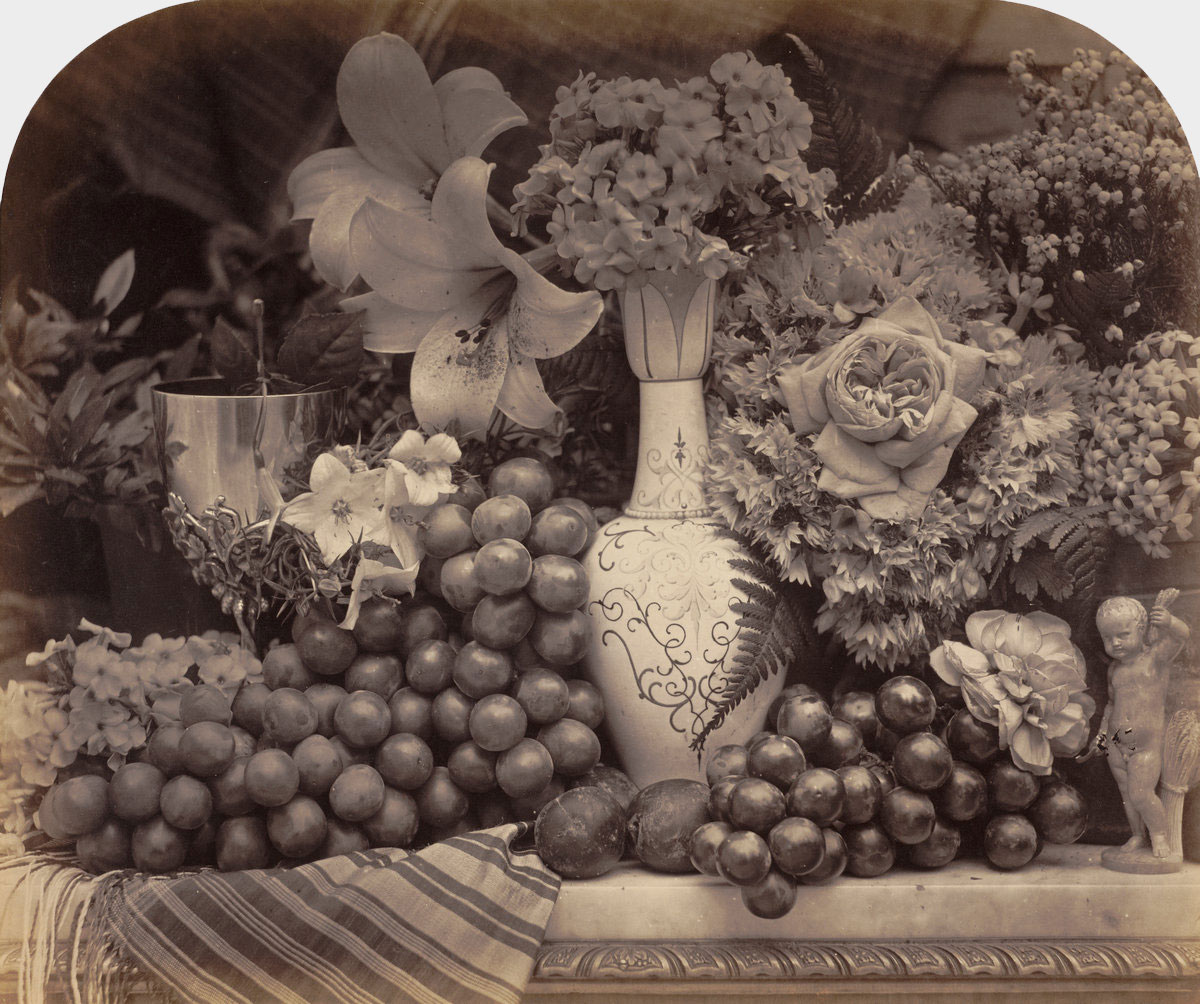

Born in 1819 to an affluent family in England, Roger Fenton was trained as a lawyer and a painter before embarking on a pathbreaking (if short-lived) photographic career. Fenton took up the new medium after seeing England’s first large display of photographs, at the Great Exhibition in London in 1851. Recognizing photography as a burgeoning field of opportunity, Fenton traveled to Paris in October 1851 to see his friend Gustave Le Gray, a leading French photographer whom Fenton most likely met when he studied painting. Le Gray taught Fenton the newly invented waxed-paper negative process. As a successful commercial photographer who was, at the same time, committed to promoting the medium as an art, Le Gray provided a model on which Fenton could base his career.
From early 1852 until early 1855, Fenton worked tirelessly to raise the stature of photography in England and to promote his own work: he published and circulated his photographs in Europe, wrote articles on photography, helped found a photographic society, and organized solo and group photography exhibitions.
In the fall of 1852, Fenton ventured to Kiev to document the construction of a suspension bridge over the Dnieper River. The photographs Fenton made in Kiev, and later in Moscow, demonstrate remarkable competence and maturity for a new photographer.
Eager to prove photography’s many applications, Fenton in 1853 became the first official photographer of the British Museum. In 1854 his work came to the attention of Queen Victoria and Prince Albert; they purchased several of his photographs and invited him to Windsor Castle to document the royal family.
.jpg)
.jpg)
.jpg)
.jpg)
.jpg)