

About the Artist
Had Jean Honoré Fragonard followed the traditional path of 18th-century artists, he well might have become the French king’s “first painter” and director of the nation’s acclaimed Académie royale. Born in Grasse in 1732, Fragonard moved with his family to Paris when he was still a young boy, and in his late teens he studied with two lions of 18th-century French painting, Jean Siméon Chardin and François Boucher. After winning the illustrious Prix de Rome in 1752, he entered the École royale des élèves protégés. Fragonard went to Rome in 1756 and stayed in Italy for five years, traveling the country, copying paintings, and working with fellow French artist Hubert Robert. He returned to Paris and based on the strength of his painting of an ancient Greek tale, he was approved by the Académie royale in 1765. Almost overnight, he came to embody the hopes of the French school and seemed poised to resurrect the fortunes of history painting, the most prestigious painting category.

Jean Honoré Fragonard
Self-Portrait, Three-Quarters to the Left, c. 1778–1780
black chalk
13 x 10.2 cm
Musée du Louvre, Paris, RF 41191
© RMN-Grand Palais / Art Resource, NY, Photo: Gerard Blot

Jean Honoré Fragonard, The Swing, c. 1775/1780, oil on canvas, Samuel H. Kress Collection, 1961.9.17
Related Resources
Online Tour: 18th-Century France — Boucher and Fragonard
Online Tour: 18th-Century France — The Rococo and Watteau
Exhibition Feature: The Age of Watteau, Chardin, and Fragonard: Masterpieces of French Genre Painting
Terms
Rococo
Genre painting
.jpg)
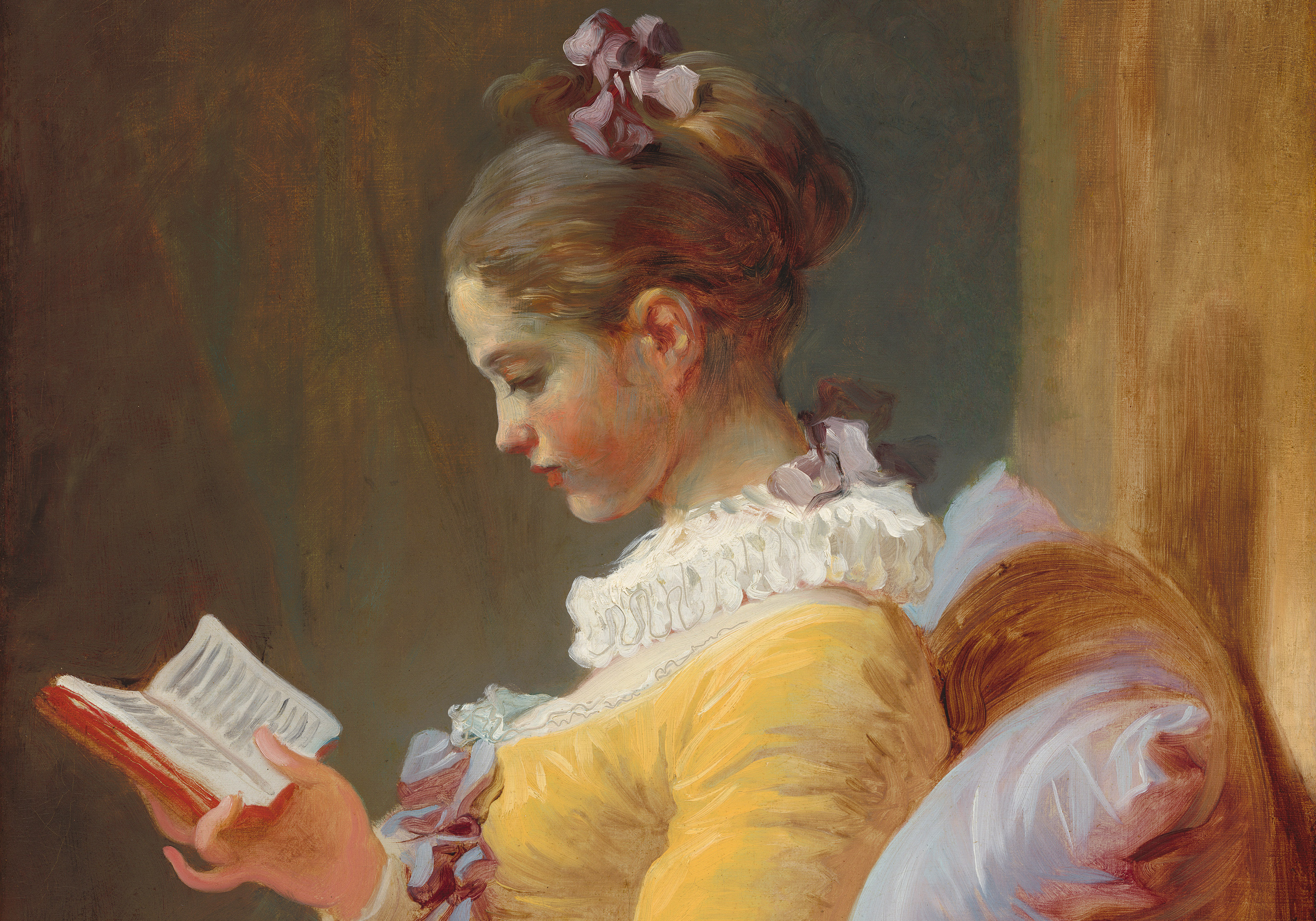
Jean Honoré Fragonard
French, 1732–1806
Young Girl Reading, c. 1769
oil on canvas
overall: 81.1 x 64.8 cm (31 15/16 x 25 1/2 in.); framed: 104.9 x 89.5 x 2.2 cm (41 5/16 x 35 1/4 x 7/8 in.)
Gift of Mrs. Mellon Bruce in memory of her father, Andrew W. Mellon
1961.16.1
Soon, however, Fragonard largely dropped out of the rigid official system that governed artists’ professional development and, to the disdain of his contemporaries, chose to work for an eager and growing market of wealthy private collectors. Freed from thematic and formal constraints, he concentrated on freely brushed small works and decorative paintings that he often infused with latent (or in some cases more explicit) eroticism. With his extraordinary imagination and artistic virtuosity, Fragonard was almost unequaled in his ability to challenge the traditions of painting and the conventions of aesthetic taste.
In the aftermath of the French Revolution, Fragonard became an important arts official and helped establish new museums at the Palais du Louvre and at Versailles. Yet by the time of his death in 1806, he had faded into obscurity, and it was not until the 1840s that his stylistic freedom—characterized by bravura brushwork and brilliant coloring—came to be seen as a singularly important precursor to Romanticism.
More Images of Women Reading
in the National Gallery of Art Collection
.jpg)
.jpg)
.jpg)
.jpg)
.jpg)
.jpg)