The Wayback Machine - https://web.archive.org/web/20250417170053/https://www.nga.gov/collection/highlights/monet-the-japanese-footbridge.html
Skip to Main Content

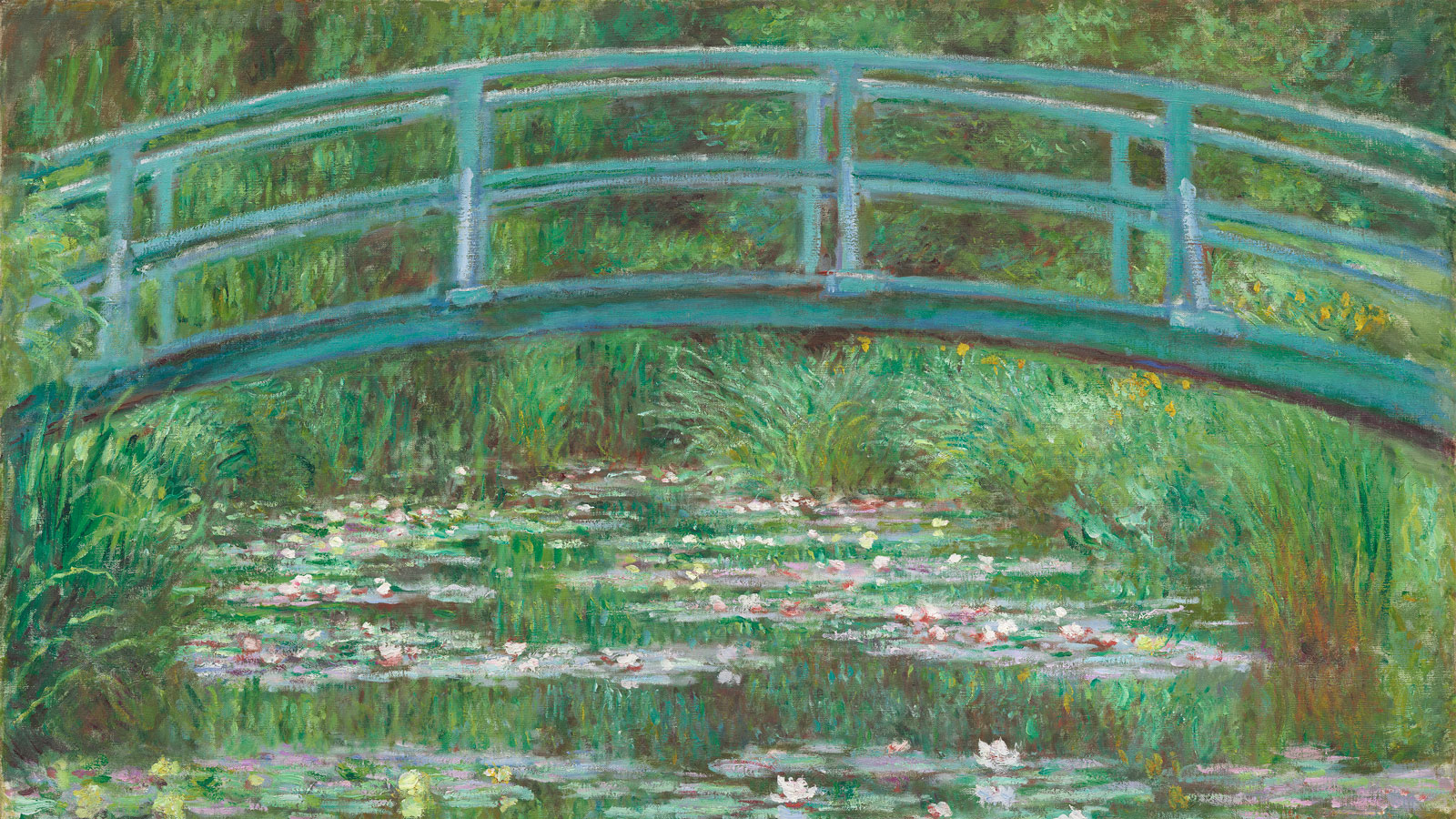
The Japanese Footbridge

Claude Monet

About the Artist

Shown from the waist up, a man sits facing us on the far side of a ledge or counter looking down at an open book in this loosely painted, vertical portrait. The man’s pale skin is flushed pink. He leans both forearms onto the ledge so his shoulders hunch forward. His head tips slightly to our left, and he reads with gathered, dark brows. He has a round-tipped nose and full, bushy beard. His black, wavy hair and beard are touched with lighter shades of bronze, especially at the temples. He holds a white pipe to his lips with one hand, and tendrils of smoke curl from the burning embers. He wears a black coat, and a slip of white cuff is visible on the hand we see. The other hand is tucked behind the first. The pages of the book are bright white, and the ledge surface is painted with strokes of celery green and ochre yellow. A swirling black form in the lower left corner of the painting is difficult to interpret. The background is painted with loose brushstrokes in shades of sky and cobalt blue and charcoal gray. The artist signed the painting near the lower left corner, “A. Renoir.”

Auguste Renoir, Claude Monet, 1872, oil on canvas, Collection of Mr. and Mrs. Paul Mellon, 1985.64.35

Claude Monet was raised on the Normandy coast in Le Havre, where his father sold ships’ provisions. He gained a local reputation as a caricaturist while still a teenager, and landscape painter Eugène Boudin invited the budding artist to accompany him as he painted scenes at the local beaches. Boudin introduced Monet to plein-air (outdoor) painting, which would prove a decisive influence in his career.

Monet went to Paris in 1862 to study painting and there befriended fellow students Auguste Renoir, Alfred Sisley, and Frédéric Bazille, who would later form the core group of the original impressionists. By the end of the 1860s, Monet had largely abandoned ambitious, large-scale figurative painting in favor of smaller, spontaneous landscape works executed en plein air.

Related Works in the
National Gallery of Art Collection

Explore all Collection Highlights