
The Wayback Machine - https://web.archive.org/web/20250331093317/https://www.nga.gov/collection/highlights/rubens-marchesa-brigida-spinola-doria.html
Skip to Main Content

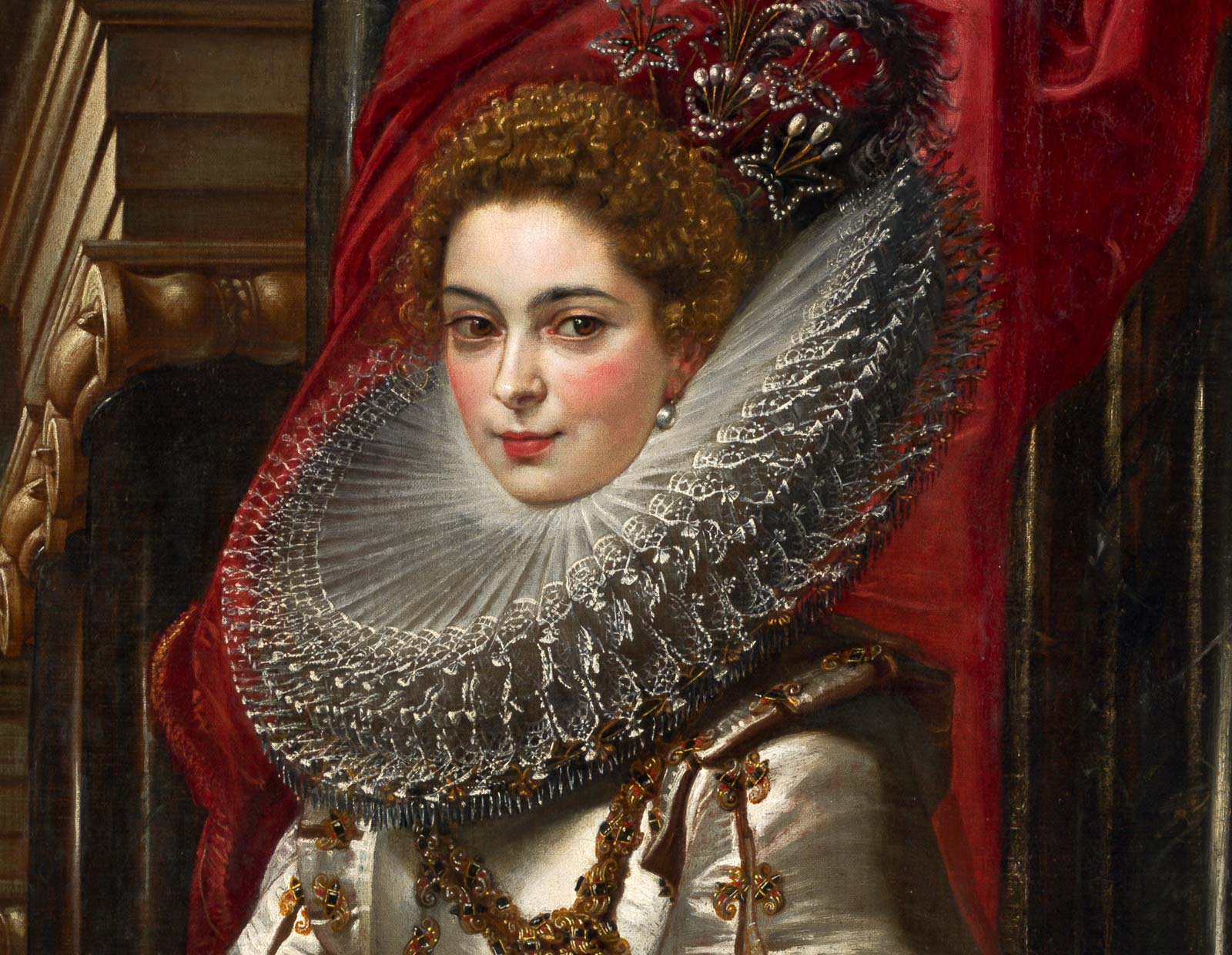
Marchesa Brigida Spinola Doria

Sir Peter Paul Rubens

Sir Anthony van Dyck, Giovanni Vincenzo Imperiale, 1626, oil on canvas, Widener Collection, 1942.9.89

A tall woman with pale white skin and a shorter man with brown skin stand on a terrace in this vertical, full-length portrait. At the center, the woman wears a voluminous, long-sleeved, black dress with a row of gold buttons down the bodice. She has a wide, gray ruffled collar at her neck and red ruffled cuffs at her wrists. Her brown hair is pulled back under a cap ornamented with rows of white pearls. She looks at us close-lipped down the bridge of her straight nose. She holds a sprig of orange blossoms in her right hand, on our left. The second person leans into the space from our right as he reaches to hold a crimson-red parasol over and behind the woman’s head. He is cleanshaven with short, dark hair and brown eyes. He wears an amber-yellow garment over a white shirt. Fluted columns rise along the right edge of the composition, and the terrace is enclosed with a low balustrade. Plants surround the woman's feet, and a distant landscape below a blue sky is visible to our left.

Sir Anthony van Dyck, Marchesa Elena Grimaldi Cattaneo, 1623, oil on canvas, Widener Collection, 1942.9.92

About the Artist

The head and chest of a man with pale pink skin, a honey-blond beard, and curly, mahogany-brown hair around a receding hairline fills this vertical portrait painting. His body and head are tipped to our left and he looks at or toward us with olive-green eyes. He has a long, pointed nose with lines around the nostrils leading down to his sweeping mustache. His soft beard below is trimmed to a point. His full, salmon-pink lips are closed. Faint sage green shades the inner corners of his eyes and the dips at his temples, beneath a shiny, balding head. His brown locks float around his face as if lifted by a breeze. His shoulders are enveloped by a chocolate-brown cloak, probably fur, and a swipe of vivid white paint at the back of his neck suggests a high, white collar. The background is mottled with rust-red, copper, and gold. The portrait is loosely painted in some areas, especially the fur cloak and background.

Anonymous Artist, Sir Peter Paul Rubens, Peter Paul Rubens, c. 1620, oil on panel, Timken Collection, 1960.6.33

Among most prolific, learned, and versatile painters of his day, Rubens was also famous as a courtier and diplomat, whose legendary tact and cultivation earned him the respect of royal courts across Europe.

Rubens was born in Westphalia, Germany. His father Jan, a Calvinist, had moved his family there from their native Antwerp, a Catholic stronghold. Jan died when Rubens was nine, and his mother, Maria Pipelinckx, moved the family back to Antwerp, where they converted to Catholicism. There, Rubens received the finest classical education available. As a teenager, he was sent to the court at Brussels, where he was schooled in social graces and the ways of the aristocracy. Rubens learned Dutch, German, French, and read Latin (later adding English and Italian). He took up drawing, initially copying the works of famous artists. As his talent became evident, Rubens began formal training as an apprentice in several painters’ studios. Sweeping biblical scenes, mythological dramas, and portraits were favored subjects from the outset of his career.

A woman with pale, peachy skin wearing elegant gold and ink-black garments sits in front of a stone portico in this vertical portrait painting. Her red armchair is angled to our right, but the woman turns to look at us under cocked brows. She has high, rosy cheekbones and a long straight nose. Her pink lips curve up in a smile framed by the faint suggestion of dimples. Her brown hair is pulled back under a gold band or net, and a gold earring hangs from the ear we see. Her gold dress has a fitted bodice with a line of buttons down the front and puffy, brocaded sleeves. She wears the bodice over a white chemise, which comes nearly to the double strand of pearls worn like a choker around her neck. Frothy white lace surges up to encircle the back of her neck, and more lace stretches back along her forearms from the cuffs of her gold dress. The black cloak she wears over the dress splits over the sleeves and flares up behind the neck, echoing the lace. A long gold chain weaves back and forth across the open front of the black cloak, which is patterned with black on black. The woman wears a ring on her right hand, which rests in her lap and holds a white flower. The cloak stops at the woman’s knees to reveal a gold and red striped skirt. The woman’s other hand, farther from us, rests along the arm of the chair and holds an ostrich' feather fan with a silver handle. A scarlet-red curtain in the upper left corner above the chair gives way to a view into a courtyard lined with a portico along the right side. The portico has three openings separated by wide, horizontally ribbed columns. Ornamental shells, creatures, and people are carved into the face of the portico, and bright green trees are just visible through the openings. Gray and white clouds sweep across a vivid blue sky around the woman’s head.

Sir Anthony van Dyck, Isabella Brant, 1621, oil on canvas, Andrew W. Mellon Collection, 1937.1.47

Rubens completed his art education with a visit to Italy, where he remained from 1600-1608. He studied Renaissance painters in Venice, and also lived in Mantua, Rome, and Genoa. With letters of introduction to the Italian nobility, he was able to secure important commissions, painting portraits and works for private chapels and churches. He left Italy to attend to his dying mother in Antwerp and never returned.

Other Works by Sir Peter Paul Rubens
in the National Gallery of Art Colleciton

Explore all Collection Highlights