The Wayback Machine - https://web.archive.org/web/20250312205848/https://www.nga.gov/collection/highlights/vermeer-woman-holding-a-balance.html
Skip to Main Content

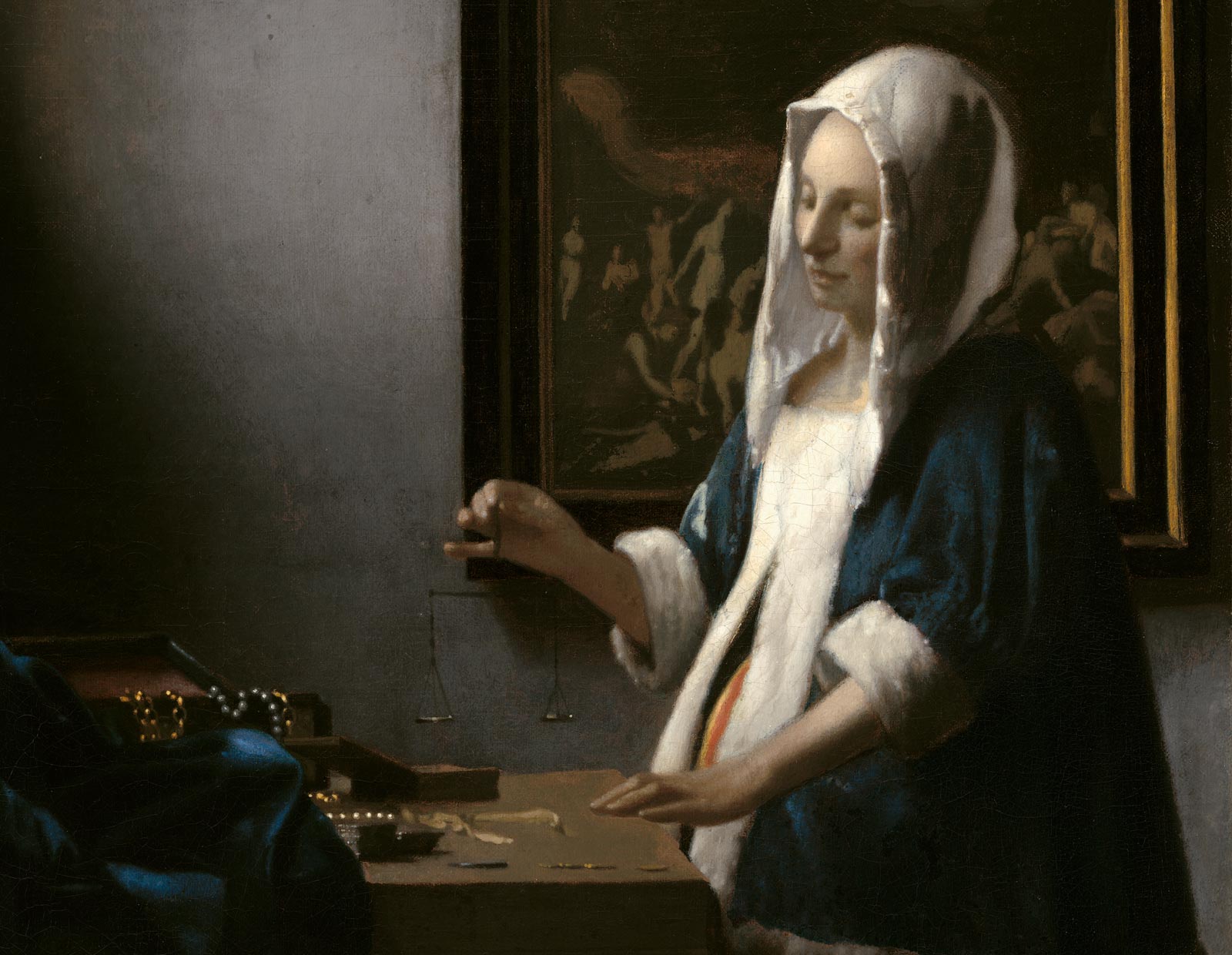
Woman Holding a Balance

Johannes Vermeer

Related Works by Vermeer in the Collection

Shown from about the knees up, a pale, smooth-skinned woman in a fur-lined yellow jacket looks out at us as she sits writing at a table in this vertical painting. The woman’s body faces the table to our left. She turns her head to gaze at us from the corners of her dark gray eyes under faint brows. She has a wide nose, and her pale lips are closed. Her light brown hair is pulled back and held in place with white bows, and gleaming teardrop-shaped pearl earrings dangle from her ears. Her lemon-yellow jacket is trimmed with ermine fur, which is white with black speckles, at the cuffs and down the front opening. A full, elephant-gray skirt falls to the floor beneath the jacket. Both hands rest on the table, and she holds a quill in her right hand, farther from us, on a piece of paper. She leans forward in her wooden chair. The back panel of the chair is covered in black fabric and lined with brass studs. Two gilded finials, carved into lions’ heads, face the woman’s back with mouths open. The table is covered with a celestial-blue cloth crumpled near the left edge of the canvas. On the table are a strand of pearls, a pale yellow ribbon, and a black box with three brown panels studded with pearls around silver keyholes. Two pewter gray vessels are visible just beyond it, in front of a second chair, which faces us. On the putty-gray wall behind the woman, a framed painting hangs in the upper left quadrant of the composition. The painting-within-the painting is done in muted tones of brown and shows a cello and other unidentifiable objects.

Johannes Vermeer, A Lady Writing, c. 1665, oil on canvas, Gift of Harry Waldron Havemeyer and Horace Havemeyer, Jr., in memory of their father, Horace Havemeyer, 1962.10.1

Shown from the waist up, a young woman sits on the other side of the edge of a table, leaning toward us on one elbow in this vertical painting. She looks at us with dark brown eyes under faint, arched brows. She has pale skin with flushed cheeks, a long, rounded nose, and her ruby-red lips are parted. Her brown hair is tucked into a wide, conical hat with gray, pale yellow, and ash-brown vertical stripes. Light falls across her face from our right, so the hat casts a shadow over her eyes and on the far cheek, to our left. Light glints off of two teardrop-shaped pearl earrings. Her muted blue bodice has a few touches of topaz and sky blue create a brocade-like floral pattern. The bodice is trimmed with a wide band of white fur down the front and around the cuffs, which come down just beyond her elbows. A white kerchief tucked into the bodice covers her shoulders. She leans onto her left forearm, to our right, and that arm is close and parallel to the bottom edge of the composition. In that hand she holds a golden flute like a pencil, and her other hand rests against the edge of the table. She leans to our right so we can see the gold lion's head finial at the top of her wooden chair. The area behind her is painted with patches of harvest yellow, fawn brown, muted brick red, and parchment white to create a loosely patterned drapery that fills the background.

Studio of Johannes Vermeer, Girl with a Flute, c. 1669/1675, oil on panel, Widener Collection, 1942.9.98

Shown from the elbows up, a young person with pale skin and brown hair wearing a wide, scarlet-red hat sits in front of a tapestry in this vertical portrait painting. She sits with her body facing our right in profile but she turns her face to look at or toward us with dark eyes. She has a rounded nose, rather flat cheeks, and a sliver of teeth is visible through parted coral-pink lips. The wide brim of the red hat seems to be made of a soft, almost feathery material, and it casts a shadow across her face. She wears a high-collared white garment that catches the light, a royal-blue, possibly velvet, robe or overcoat, and large, teardrop pearl earrings. Her arm runs along the bottom edge of the panel in front of two carved, wooden lion finials that could be the arm or back of the chair. The tapestry behind her is painted in tones of pale caramel brown and pine green. The painting has a soft, hazy look, and light glints with bright white specks off the pearl earrings, the tip of her nose, her lips, and the lion finials.

Johannes Vermeer, Girl with the Red Hat, c. 1669, oil on panel, Andrew W. Mellon Collection, 1937.1.53

About the Artist

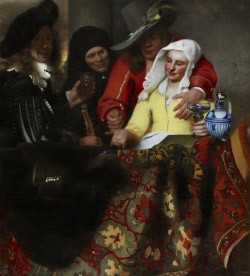
The Procuress

Johannes Vermeer, The Procuress (De koppelaarster), 1656
. Staatliche Kunstsammlungen 
Alte Meister (Gemäldegalerie Alte Meister), Dresden.

It is possible that the young man pictured at the left could be Vermeer’s self-portrait, although there has been no written evidence to confirm it. The artist would have been 24 at the time.

Johannes Vermeer is today one of the most famous European artists of all time. He was born and died in the city of Delft, with which he is strongly associated. His father Reynier was a weaver of fine cloth, which provided the family a comfortable living. In 1631, the year before Johannes was born, his father joined the St. Luke's Guild as a picture dealer.

No records document Vermeer’s early artistic training and apprenticeship—neither where nor with whom he trained. In 1653 he registered as a master painter with the St. Luke’s Guild and had inherited Reynier’s art-dealing business the previous year. In April 1653 he married a Catholic, Catharina Bolnes, whose mother, Maria Thins, exerted significant influence over the couple’s lives. She is likely to have required Vermeer, born a Reformed Protestant, to convert to Catholicism. Johannes and Catharina eventually moved into Maria’s house.

Vermeer’s early ambition was to become a history painter. By the mid-1650s, however, he had turned to domestic scenes and had begun to express his interest in various techniques and devices that could aid him in creating lifelike effects. For example, he seems to have used the camera obscura, a pinhole device used to project an image onto a wall surface with a lens. The device exaggerated spatial effects, and the projected image was probably not sharply focused. Vermeer often incorporated blurred effects in his work, similar to those created by the camera obscura.

Explore all Collection Highlights