Travels Across Russia: 1889: J. Guthrie Watson’s ‘A Journey Across Russia’ Album
Cover
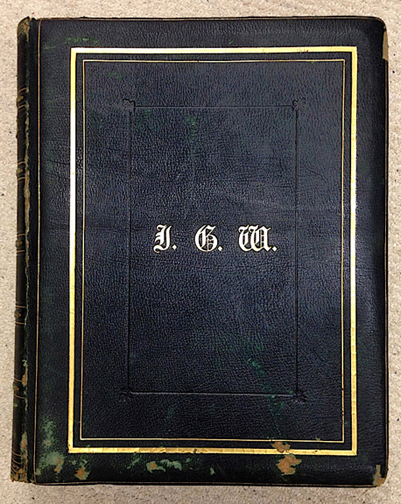
This oversized album with J. Guthrie Watson’s initials in gilt on the cover was likely assembled upon his return to England. Although it is not certain how many of the views in this album were photographed by Watson himself, in 1899 he exhibited a collection of photographs at the Anthropological Institute in London. The following images are albumen prints, unless otherwise specified.
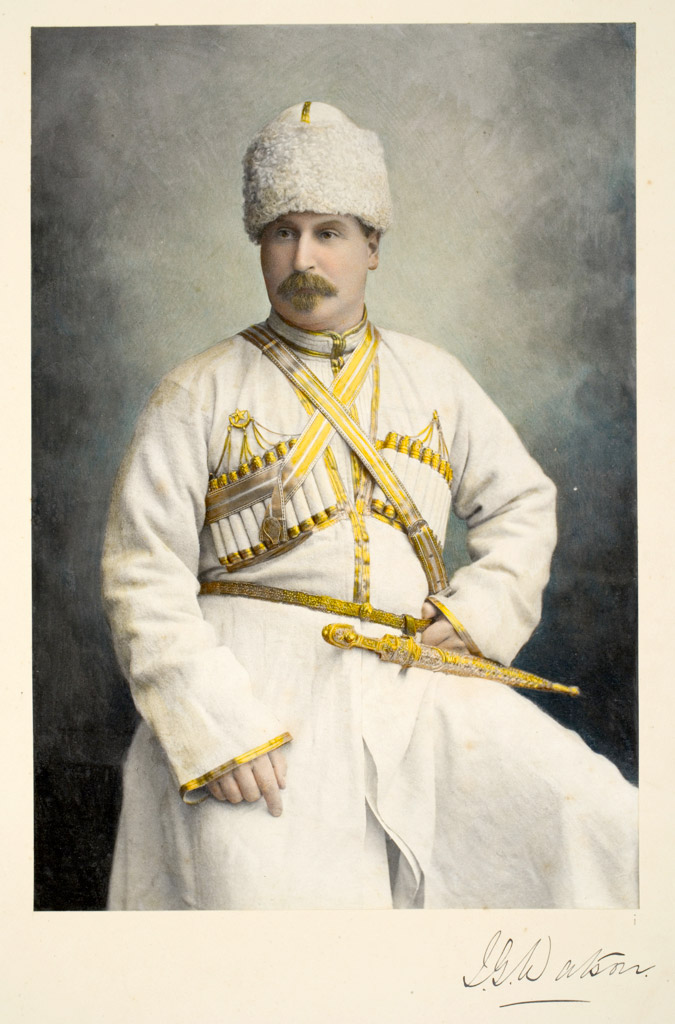
Hand-colored portrait of J. Guthrie Watson, the collector and possibly the photographer of some the images here, in ceremonial Cossack dress.
A member of the Conservative Club in London, Watson appears to have been a former military officer and was, in his words, “well acquainted with the Caucasus (particularly that portion known as Circassia).”
View of the monument to Alexander I (1777–1825) with the Winter Palace in background.
Saint Petersburg, Russia
Alexander Column, 1830–1834, designed by Auguste Ricard de Montferrand (1786–1858).
Tsarskoe Selo was an imperial residence south of Saint Petersburg.
Tsarskoe Selo, Russia
Catherine Palace, 1748–1756, designed by Francesco Bartolomeo Rastrelli (c. 1700–1771)
Peterhof was an imperial residence in Saint Petersburg.
Peterhof, Russia
Estate, Great Palace, 1714–1752, designed by Francesco Bartolomeo Rastrelli
The Kingdom of Poland was subsumed into the Russian Empire in 1867. By the end of the 19th century, Warsaw had become the third-largest city of the empire after Saint Petersburg and Moscow. The Łazienki Palace (or Water Palace), originally built 1683–1689 from designs by Dutch-born Polish architect Tylman van Gameren, was entirely remodeled by Domenico Merlini in 1764–1795.
Warsaw, Poland
Łazienki Palace, 1764–1795, designed by Domenico Merlini (b. 1730/1731–1797)
Saint Petersburg, Russia
Cathedral of Saint Isaac, 1818–1858, designed by Auguste Ricard de Montferrand
Saint Petersburg, Russia
Cathedral of the Kazan Mother of God, 1801–1811, designed by Andrey Voronikhin (1759–1814)
Saint Petersburg, Russia
View of Nevsky Prospect with Anichkov Bridge, 1841–1842, rebuilt 1906–1908. Sculptures of The Horse Tamers by Pyotr Karlovich Klodt (1805–1867). View also shows Belosselsky-Belozersky Palace, 1747
Saint Petersburg, Russia
View of Nevsky Prospect
Moscow, Russia
Kremlin, panorama (heavily hand-colored)
Moscow, Russia
Kremlin, Cathedral of Christ the Savior (hand-colored)
Designed 1832 by Konstantin Thon (1794–1881), built 1839–1860, demolished 1931, rebuilt 1994–2000
Moscow, Russia
Kremlin, Cathedral of Christ the Savior (hand-colored)
Designed 1832 by Konstantin Thon (1794–1881), built 1839–1860, demolished 1931, rebuilt 1994–2000
Moscow, Russia
Cathedral of the Intercession on the Moat (Saint Basil) (hand-colored)
Designed 1555–1561 by Barma (active c. 1555–1560) and Posnik Yakovlev (active c. 1550–1562)
Moscow, Russia
Panorama, Red Square with the Cathedral of the Intercession on the Moat, the Redeemer’s Gate, and monument to Minin and Pozharsky (hand-colored)
This 17th-century birthplace of the founder of the Romanov dynasty, Tsar Michael I, was restored by order of Tsar Alexander II and opened as a museum in 1859.
Moscow, Russia
Chambers of the Romanov Boyars (hand-colored)
Sergiyev Posad, Russia
Panorama, Trinity-Sergius Monastery, 15th–18th centuries (hand-colored lithograph)
Moscow, Russia
Kremlin, Spassky Tower, 1491; upper tower added 1624–1625
Designed by Pietro Antonio Solari (c. 1440 or c. 1450–1493), Bazhen Ogurtsov (active first half 17th century), and Christopher Galloway (active 1624–1645)
The Tsar Bell (Tsarsky Kolokol III or Royal Bell) resides on the grounds of Moscow’s Kremlin. The first two Tsar Bells were destroyed by fire; this third bell was also damaged in a fire, during casting. It remained in the casting pit for nearly a century until it was raised in 1836 by French architect Auguste Ricard de Montferrand and placed on a stone pedestal. It has never rung.
Moscow, Russia
Kremlin, Tsar Bell, casting begun 1735, damaged 1737, mounted on pedestal 1836
Moscow, Russia
Panorama, Kremlin
Probably Moscow, Russia
View of a troika, the characteristically Russian three-horse carriage
Sergiyev Posad, Russia
Panorama, Trinity-Sergius Monastery, 15th–18th centuries (colored lithograph)
Unidentified monastery (colored lithograph)
This early 19th-century church was demolished by the Soviets, and rebuilt beginning 2007
Sergiyev Posad, Russia
Savior-Bethany Monastery, Church of the Transfiguration (colored lithograph).
Kiev, Ukraine
Panorama, Monastery of the Caves, 11th and 18th centuries (colored lithograph)
Saints of the Pechersk Lavra from the Monastery of the Caves, Kiev, Ukraine (chromolithograph)
Dormition of the Virgin from the Monastery of the Caves, Kiev, Ukraine (chromolithograph)
Kiev, Ukraine
Saint Michael's Monastery, 12th century, rebuilt 18th century, demolished 1930s, reconstructed and reopened 1999 (colored lithograph)
Silver shrine of Saint Barbara from Saint Michael's Monastery, Kiev, Ukraine
Icon of Saint Michael from Saint Michael's Monastery, Kiev, Ukraine
Kiev, Ukraine
Saint Michael's Monastery with police station and law courts at left
Kiev, Ukraine
Panorama, Monastery of the Caves, 11th and 18th centuries
Bohdan Khmelnytsky was a hetman (head of state) of the Zaporozhian Cossacks who liberated Kiev from Polish rule and is regarded as the father of the Ukraine.
Kiev, Ukraine
Cathedral of Saint Sophia, c. 1037–1060, with monument to Bohdan Khmelnitsky at extreme right (cyanotype)
Kiev, Ukraine
Saint Vladimir, late 19th century (cyanotype)
Nizhny Novgorod, Russia
View from the Kremlin
Nizhny Novgorod, Russia
View of upper town and Kremlin
The Nizhny Novgorod Fair succeeded the Makaryev Fair, an annual commercial event which attracted international goods from all over Central Asia, Persia, and India. From the mid-16th century, the fair was held July to September at the Makaryev Monastery on the Volga River. In 1816, the fairgrounds were destroyed by fire and the fair moved to Nizhny Novgorod. Although damaged during the revolution and closed in 1929, the fair was revived in 1990.
Nizhny Novgorod, Russia
Panorama, Chinese rows of the Nizhny Novgorod Fair, 1817–1825, designed by Auguste Ricard de Montferrand. The Cathedral of the Transfiguration of the Savior is visible in the center background.
Odessa was founded at the order of Russian Empress Catherine the Great in 1794. Its development was cultivated by Duc de Richelieu, who fled to Russia during the French Revolution and was appointed by Tsar Alexander I as the governor-general of the Crimea and governor of Odessa from 1803 to 1814.
Odessa, Ukraine
Panorama
The great poet Alexander Sergeyevich Pushkin (1799–1837) is considered the originator of modern Russian literature.
Odessa, Ukraine
Nicholas Boulevard with the monument to Pushkin
Odessa, Ukraine
Opera theater, 1884–1887, designed by G. Gelmer (active 1880s) and Ferdinand Fellner (1847–1916)
The Siege of Sevastopol (September 1854–September 1855) was the last major military action of the Crimean War.
Sevastopol, Ukraine
Panorama
This cemetery commemorated the Allied dead from the Crimean War Siege of Sevastopol and was largely destroyed during World War II.
Sevastopol, Ukraine
The British memorial complex with guard’s monument on Cathcart's Hill, 1854–1856
Yalta, on the north coast of the Black Sea in Crimea, became a popular resort for Russian nobility in the 19th century. Tsar Alexander III and later Nicholas II built palaces in the area, and literary luminaries Leo Tolstoy and Anton Chekhov also resided there.
Yalta, Ukraine
Panorama with Hôtel de Russia
Balaclava was the site of the 1854 Crimean War battle that included the fateful “Charge of the Light Brigade,” immortalized in the poem by Alfred, Lord Tennyson.
Balaclava, Ukraine
Panorama
Ceded to Russia in 1829 after the Russo-Turkish War, the port of Novorossiysk was the capital of the Black Sea Governorate.
Novorossiysk, Russia
Panorama, harbor
Novorossiysk, Russia
Panorama of piers for loading grain
Novorossiysk, Russia
Panorama of ship struggling against the Bora, the violent wind off the Black Sea
By 1810, Russia claimed Sukhum Kaleh (Sukhumi) as a base in the northwest Caucasus.
Sukhum Kaleh, Georgia
Panorama near Batum
Tbilisi, Georgia
Panorama with floating water mills on Kura River (right foreground)
Tbilisi, Georgia
Panorama
Georgia joined the Russian Empire in 1801, with Tbilisi (Tiflis) becoming a governorate. As improved transportation connected Tbilisi to other cities in the Caucasus and Russia, Tbilisi reemerged as a cultural center, and was often visited by Leo Tolstoy, Pushkin, and other artists and statesmen.
Tbilisi, Georgia
Panorama
After Georgia became part of the Russian Empire, this town southwest of Tbilisi, in the Lesser Caucasus, became a popular spa resort and home to Grand Duke Michael Nicolaievich, the governor general of Transcaucasia.
Borjomi, Georgia
Panorama with the Grand Duke’s summer residence
Mount Elbrus is the highest peak in the Russian Caucasus, and the highest mountain in Europe.
Mount Elbrus, Georgia
Panorama
Mount Kabarjin, Georgia
Panorama of Kobi village
Mount Kazbek is highest peak of Eastern Georgia.
Mount Kazbek, Georgia
Panorama
This Russian settlement in the Caucasus was founded in the late 18th century and by 1803 had become a popular mineral springs resort. The statue shown here is of Mikhail Yuryevich Lermontov, the Russian writer, poet, and painter who had been exiled to serve in the Russian cavalry in the Caucasus and was killed in a duel here in Pyatigorsk in 1841.
Pyatigorsk, Russia
Cathedral Square with statue of Lermontov
Russia established a fort at Vladikavkaz in the Caucasus in 1784. The city is now the capital of the Republic of North Ossetia-Alania, Russia.
Vladikavkaz, Russia
Panorama
Mount Ararat on the Turkey-Iran border is the highest peak in Turkey. Judeo-Christian tradition identifies the mountains of Ararat as the spot where Noah's ark came to rest.
Mount Ararat, Turkey
Panorama with a regiment of Cossacks
Erzurum, Turkey
Panorama with the Citadel
In 1813, Persia ceded Baku and most of the Caucasus to Russia. Located on the Absheron Peninsula on the west side of the Caspian Sea, Baku today is the capital and largest city of Azerbaijan.
Baku, Azerbaijan
Panorama of town and port
Baku, Azerbaijan
View of the quai
The Baku area was rich in oil and, by the beginning of the 20th century, produced nearly half of the world’s supply.
Baku, Azerbaijan
Panorama of Black Town, showing petroleum refineries
Baku, Azerbaijan
Panorama of a petroleum spout
Circassia was a nation that spanned the east Black Sea coast between Crimea and the Caucasus. By 1864, this area had been overrun by the Russian Empire—the population decimated and the few survivors refugees in the Ottoman Empire.
Russian lady in Circassian dress
Circassian man and woman
Circassian lady
Mingrelia was a principality in western Georgia that was conquered by and subsumed into Russia in 1857.
Woman of Mingrelia
Georgian woman
Although Watson mistakenly captions this photo as "Tartar Woman," this traditional tuman (skirt) and kyuladzha (outerwear) identify her as from the Nakhchivan region of Azerbaijan. The Nakhchivan Khanate came under Imperial Russian control in 1828, and today the area is the Nakhchivan Autonomous Republic, an enclave of the Republic of Azerbaijan, which shares borders with Armenia, Iran, and Turkey.
Azerbaijani woman of a noble family from the Nakhchivan district
Armenian woman
Georgian carriage
Dagestan (or Daghestan) in the north Caucasus came under Russian authority in 1803, although resistance to imperial authority continued sporadically throughout the 19th century. Today, Dagestan is a Russian republic.
“King of Dagestan”
In 1869, imperial Russia established a fort in Krasnovodsk. Since 1993 called Türkmenbaşy (or Turkmenbashi), this city on the eastern shore of the Caspian Sea was the western terminus of the Trans-Caspian Railway and an important transportation center.
Krasnovodsk, Turkmenistan
Panorama
This Caspian island seaport was the original starting point of the Trans-Caspian Railway (later moved to Krasnovodsk).
Uzun-Ada, Turkmenistan
Ashgabat, or Ashkhabad, situated between the Kara Kum desert and the Kopet Dag mountain range, is the capital of Turkmenistan. Founded in 1881, the town was ceded to Russia by Persia after the Battle of Geok Tepe.
Ashgabat, Turkmenistan
Caravanserai
Ashgabat, Turkmenistan
Ice house
Merv was a major oasis-city on the historic Silk Road. Located near today's Mary in Turkmenistan, it has been inhabited since the third millennium BC.
Merv, Turkmenistan
Panorama, village of Baba Khan
Merv, Turkmenistan
Panorama
Merv, Turkmenistan
Panorama, bazaar
“Uzbek residence of Fairchaikh Tchylek”
Khiva (or Khorezm) became a quasi-independent protectorate of the Russian Empire after 1873.
Khiva, Uzbekistan
Itchan Kala, Kunya-Ark (Citadel), gate of the walled city, 1686–1888
Khiva, Uzbekistan
New Kiosk of the Khan
Khiva, Uzbekistan
Tash Khauli Palace, 1830–1838
Begun under the rule of Mohammed Amin Khan and left unfinished upon his death, this minaret was intended to be twice as tall, tapering to a domed gallery. Kalta-Minor means “short minaret.”
Khiva, Uzbekistan
Kalta Minor minaret, 1851–1855
Bukhara (or Bokhara), on the Silk Road in Uzbekistan, has long been a center of trade, scholarship, culture, and religion.
Bukhara, Uzbekistan
Panorama
Bukhara, Uzbekistan
Street scene
Bukhara, Uzbekistan
Citadel (Ark), Palace of the Emir, 16th century
Khotoun, Uzbekistan
Daya Fortress, between Khiva and Samarkand
Darganata, Turkmenistan
Fortress, between Khiva and Samarkand
Samarkand, on the Silk Road to China, is today the second-largest city in Uzbekistan. In the 14th century it was the capital of the empire of Timur (Tamerlane). Russia conquered the city in 1868 and by 1886 Samarkand became the capital of Russian Turkestan.
Samarkand, Uzbekistan
View from the Citadel
Samarkand, Uzbekistan
Panorama, Saddler’s Street
Samarkand, Uzbekistan
Panorama
Samarkand, Uzbekistan
Madrasah Khodja Akhcar, 1632
Bazaar Day.
Samarkand, Uzbekistan
Bibi-Khanym Mosque, 1399
Samarkand, Uzbekistan
Cathedral, 19th century
Samarkand, Uzbekistan
Shah-i-Zinda Necropolis, 9th–14th centuries
Samarkand, Uzbekistan
Shah-i-Zinda Necropolis, viewed from the bazaar
Probably near Samarkand, Uzbekistan
Race course
“Balachonpaky Village on the Orek Vay Tchylek.”
Samarkand, Uzbekistan
Khuja Khidr Mosque on the Tashkent Road
Sart village, probably in Uzbekistan
At the time this album was compiled, Russians used the term Sart to denote any of the settled peoples of Turkestan.
Sart children
Sart outdoor dress
Sart woman
The Teke are one of the main Turkmen tribes. After the 1881 battle of Geok Tepe, in which the Teke were defeated, Turkmenistan became a part of the Russian Empire.
Teke Turkoman women
The Khans of Khiva descended from Genghis Khan. In 1873, the Khanate of Khiva was became a Russian protectorate.
Musicians of the Khan of Khiva
Turkoman Cavalry
The renowned horsemen of Central Asia
Ram fight

Formed in 2009, the Archive Team (not to be confused with the archive.org Archive-It Team) is a rogue archivist collective dedicated to saving copies of rapidly dying or deleted websites for the sake of history and digital heritage. The group is 100% composed of volunteers and interested parties, and has expanded into a large amount of related projects for saving online and digital history.