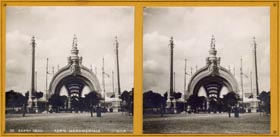
Stereographs (also called stereograms) were double photographs intended to be viewed with a stereoscope to give a three-dimensional impression of the subject. By 1900, stereographic sets documenting world events or famous works of art and architecture were so popular that they were sold in department stores and door to door. This set of stereographs, published by the Collection Stéréoptique Félix Potin, records this last and largest exposition of the 19th century. Other images of the 1900 Paris exposition in image collections include albums by Neurdein Frères.
Exposition Universelle de 1900
Paris, April 15–November 12, 1900
Main Entrance (Porte Monumental) René Binet, architect View of the entire stereo card.
Click a slide to view a larger image and detailed description
Main Entrance (Porte Monumentale)
René Binet, architect
This controversial structure on the Place de la Concorde was both ridiculed
and praised by the Parisian press. Beneath its grand arch were ticket
booths for entrance into the fairgrounds.
Main Entrance (Porte Monumentale)
René Binet, architect
This detail shows the entry area beneath the grand arch.
Celestial Globe (Globe Céleste) and Eiffel Tower
The Eiffel Tower was designed by Gustave Eiffel for the
Paris Exposition Universelle of 1889. Construction began in 1887.
Grand Palais
Henri Daglane, Louis Albert Louvet,
Charles Louis Girault, and Albert Théophile Félix Thomas, architects
This beautiful palace housed the Centennale, an exhibition of 19th-century
French art; the Décennale, an exhibition of French art from the previous decade;
and international works of art. Today it holds the Galeries Nationales
du Grand Palais, a planetarium, and the Palais de la Découverte.
Petit Palais
Charles Louis Girault, architect
Situated opposite the Grand Palais, the Petit Palais housed a retrospective exposition
of French arts. Today it is home to the Musée des Beaux-Arts de la Ville de Paris.
Pavilion of Asiatic Russia (Palais de l’Asie Russe)
Roman Meltzer, architect
This grand complex of structures, designed by one of Russia’s preeminent architects,
was built in the form of a kremlin (fortress) in a Russian revival style.
Palace of Metallurgy and Mines (Palais de la Metallurgie et des Mines)
Marcellin Varcollier, architect
This building on the Champs-de-Mars was dedicated to the mining and
metalwork industries. It included exhibits of coal, gems, and cast iron.
Palace of Metallurgy and Mines
(Palais de la Metallurgie et des Mines)
Marcellin Varcollier, architect
This detail shows the elaborate façade of the vast
exhibition hall dedicated to mining and metalwork.
Pavilion of Italy (Palais de l’Italie)
Carlo Cepi, C. Gilodi, and Giuseppe Salvadori, architects
The design of this palace, Built in a style derived from the Venetian Gothic, skillfully combines details from the
Doge’s Palace and the basilica of San Marco.
Pavilion of Serbia
Ambroise Baudry, architect
Described at the time as in the "Serbo-Byzantine" style, this pavilion
housed an exhibit of wines, pork products, and silk, including a display of silkworm
cocoons, and an array of Serbian national costumes.
Conservatories of the City of Paris (Grandes Serres)
Charles Gautier, architect
These two greenhouses occupied the left bank of the Seine, one with native
French plants, the other with foreign and exotic horticultural displays.
Moving Sidewalk (Trottoir Roulant)
Schmidt and Silsbee, architects
The fun of getting on and off this electric three-tiered sidewalk (one level stationary,
the next moving at four kilometers per hour, the third at nine kilometers per hour) made it one of the fair's
greatest amusements. Schmidt and Silsbee were American engineers.
The library is open Monday through Friday 11:00 a.m. to 4:30 p.m. We are closed Saturday, Sunday, and federal holidays.
To help us prepare materials ahead of your initial visit, we recommend you request an appointment.
Location
National Gallery of Art East Building
4th Street and Pennsylvania Avenue NW
Washington, DC
Mailing Address
Image Collections
National Gallery of Art
2000 South Club Drive
Landover, MD 20785
Contact [email protected] or call (202) 842-6026

Formed in 2009, the Archive Team (not to be confused with the archive.org Archive-It Team) is a rogue archivist collective dedicated to saving copies of rapidly dying or deleted websites for the sake of history and digital heritage. The group is 100% composed of volunteers and interested parties, and has expanded into a large amount of related projects for saving online and digital history.