-
July 24, 2018 • 1:04:54
Alexander Alberro, Virginia Bloedel Wright Professor of Modern and Contemporary Art History Barnard College/Columbia University, and James Meyer, curator of art, 1945–1974, National Gallery of Art. On June 10, 2018, at the National Gallery of Art, Alexander Alberro joined James Meyer to discuss the publication of Abstraction in Reverse: The Reconfigured Spectator in Mid-Twentieth-Century Latin American . Their conversation explores how Latin American art in the mid-20th century has shaped and reimagined the interconnection between art and its public, as well as the role of the spectator in the realization of the artwork. What was the relationship of 20th-century Latin American artists to the North American and European legacy? What significance did the art of Latin American artists have during this time? What role did both artist and public play in the process of creating the artwork? And to what extent did this movement evolve beyond South America?
-
April 22, 2014 • 57:46
Darryl Atwell, a collector based in Washington, DC, has been acquiring works by artists of the African diaspora for the last eight years. His conversation with Jeffreen M. Hayes, Andrew W. Mellon Curatorial Fellow in African American Art, Birmingham Museum of Art, recorded on November 18, 2012, as part of the National Gallery of Art lecture series The Collecting of African American Art , provides an overview of Atwell’s important collection. They also discussed the collecting of African American art in general and the rise of contemporary African American artists. Hayes is a scholar whose research interests are African American visual culture, contemporary representations of race, and art museums.
-
October 2, 2012 • 56:59
Recorded on February 26, 2012, as part of the National Gallery of Art lecture series The Collecting of African American Art, former National Basketball Association players Elliot Perry and Darrell Walker discuss their collections of African American art and art of the African diaspora with Professor Michael D. Harris. Perry and Walker began to collect art during their extensive travels for their professional sports careers, and both have amassed important holdings of modern and contemporary art that have been exhibited throughout the United States. Both have also dedicated themselves to educational and philanthropic causes to preserve and showcase African American culture. Professor Harris is an artist, curator, and scholar of contemporary African and African American art and has contributed to the exhibition catalogue Images of America: African American Voices: Selections from the Collection of Mr. and Mrs. Darrell Walker.
-
October 4, 2016 • 39:21
Artists Leonardo Drew and Jennie C. Jones with Pamela J. Joyner, collector. The Joyner/Giuffrida Collection of Abstract Art is widely recognized as one of the most significant collections of modern and contemporary work by African and African Diasporan artists. Four Generations: The Joyner Giuffrida Collection of Abstract Art draws upon the collection’s unparalleled holdings to explore the critical contributions made by artists to the evolution of visual art in the 20th and 21st centuries. Extensively illustrated with hundreds of works in a variety of media, and featuring scholarly texts by leading artists, writers, and curators, Four Generations gives an essential overview of some of the most notable artists and movements of the last century, up to and including works being made today. The collection features major works by artists such as Beauford Delaney, Jacob Lawrence, Alma Thomas, David Hammons, Sam Gilliam, Lauren Halsey, Oscar Murillo, Jayson Musson, Robin Rhode, Zander Blom, and Lynette Yiadom-Boakye. In honor of the book publication, Pamela J. Joyner joins artists Leonardo Drew and Jennie C. Jones in this conversation held on September 25, 2016, at the National Gallery of Art as part of the series, The Collecting of African American Art.
-
April 18, 2022 • 48:44
Kanitra Fletcher, Molly Donovan, and Steven Nelson introduce Afro-Atlantic Histories, drawing parallels between the visual cultures of the Afro-Atlantic diaspora and taking an in-depth look at the works of art, historical experiences, and cultural formations of Black and African people since the 17th century.
-
December 26, 2017 • 40:31
Amy Sherald, artist, in conversation with Erin Christovale, assistant curator at the Hammer Museum. Amy Sherald (b. Columbus, Georgia, 1973) received her BFA from Clark Atlanta University in 1997 and her MFA from Maryland Institute College of Art in 2004. Sherald paints dynamic portraits designed to divulge an erudite understanding of the psychological consequences of stereotyping and racism. Each portrait depicts a friend or acquaintance suspended in vivid fashions before a nondescript background; skin tones are represented using a grayscale as a way of challenging the concept of color-as-race. Sherald is critical of African American cultural history and the representation of black bodies, and her portraits are satirical manifestations of identities shaped by political, social, economic, and cultural influences. In 2016 Sherald was the first woman to win the Outwin Boochever Portrait Competition grand prize from the Smithsonian National Portrait Gallery. The Outwin 2016: American Portraiture Today exhibition tours to three other US museums until January 2018. Other recent group shows include Southern Accent, coorganized by the Nasher Museum of Art at Duke University and the Speed Art Museum, Louisville, and Face to Face: Los Angeles Collects Portraiture at the California African American Museum in Los Angeles. Her next solo exhibition opens at the Contemporary Art Museum St. Louis in mid-2018. Sherald lives and works in Baltimore. In this conversation held on October 29, 2017, at the National Gallery of Art, Sherald discusses her career, artistic process, and latest projects with Erin Christovale. This program is coordinated with Now Be Here #4, DMV , the fourth and final US iteration of a project to gather female and female-identifying visual artists for a group photograph of historic proportions.
-
January 9, 2018 • 1:03:40
James Meyer, curator of art, 1945–1974, National Gallery of Art, and Alexandra Truitt, independent photo editor and picture researcher, and manager, Estate of Anne Truitt. The studio life of Anne Truitt (1921–2004) is explored in the focus exhibition In the Tower: Anne Truitt , on view from November 19, 2017, through April 1, 2018. The first major presentation of Truitt's work at the National Gallery of Art, the exhibition celebrates the museum's acquisition of several major artworks by Truitt in recent years, including seminal works from the collection of the Corcoran Gallery of Art, as well as several outstanding loans. Bringing together nine sculptures, two paintings, and 12 works on paper representing the different media in which the artist worked, the exhibition traces Truitt's artistic development from 1961 to 2002. One of the most original and important sculptors to emerge in the United States during the 1960s, Truitt is unique in the field of minimalist art. She hand-painted her sculptures in multiple layers to create abstract compositions of subtle color in three dimensions. Her art is infused with memory and feeling, unlike much minimalist art, and while most of her peers were based in New York or Los Angeles, she worked alone and independently in Washington, DC. In this conversation held on the exhibition’s opening day, James Meyer and Alexandra Truitt discuss the artist’s career and her body of work developed in a series of local studio spaces.
-
March 29, 2016 • 58:32
Alexandre Arrechea, artist, in conversation with Michelle Bird, curatorial assistant, department of French paintings, National Gallery of Art. Alexandre Arrechea (b. Trinidad, Cuba, 1970) graduated from the prestigious Instituto Superior de Arte (ISA) in Havana in 1994 and was a founding member of the Cuban artist collective Los Carpinteros (1991-2003). Arrechea’s work employs visual metaphors for social themes of inequality, cultural disenfranchisement, and the disputed position of art in a global, media-driven society. Like many artists of his generation, he manipulates symbols and materials in an ambivalent manner, causing the viewer to walk away without a specific point of view about the work. In the spring of 2013, Arrechea exhibited a series of monumental sculptures that reflect on New York architecture along the Park Avenue Malls. Arrechea represented his homeland in the Cuban Pavilion at the Venice Biennale in 2011, as well as at the Havana and Sao Paulo Biennials. His work has been featured in group exhibitions at such venues as the Arizona State University Art Museum; Art in General, New York; Kunsthalle, Berlin; Los Angeles County Museum of Art; Museum of Art and Design, New York; Museum of Modern Art, New York; New Museum, New York; P.S. 1 Contemporary Art Center, New York; and Shanghai Art Museum, China. He currently lives and works in New York. In this conversation held on January 25, 2016, as part of the Works in Progress series at the National Gallery of Art, Arrechea discusses with Michelle Bird his development from working as an art student in Havana to his international career. He shares how the term “Space Defeated” was born as a reaction to the stiffness of cultural institutions and how this understanding has evolved over time. The conversation was preceded by a film screening of NOLIMITS , based on Arrechea’s 2013 project, directed by photographer Juan Carlos Alom.
-
January 29, 2021 • 43:31
Reginald Dwayne Betts, poet and PhD in Law candidate, Yale Law School; Candice C. Jones, president and CEO, Public Welfare Foundation of Washington, DC; Richard Ross, artist and Distinguished Research Professor of Art at the University of California, Santa Barbara In a previously recorded conversation, artist Richard Ross; Candice C. Jones, president and CEO of Public Welfare Foundation; and poet and legal scholar Reginald Dwayne Betts discuss the role of the arts in eliciting, supporting, perhaps demanding social change. Together, as activists and artists, they unpack the complex interplay between art, institutions, and advocacy. An award-winning memoirist and poet, Betts has written extensively on the American legal and justice system, telling his own stories of injustice and bringing to light those of others. He conceptualized and brought to life—through a joint partnership with Yale Law School’s Justice Collaboratory and support from the Andrew W. Mellon Foundation—the Million Book Project, which will distribute a curated 500-book collection to 1,000 medium- and maximum-security prisons across every state. “the artifice of justice” is a phrase from Betts’s poem titled “When I Think of Tamir Rice While Driving,” published in Felon: poems. Prior to Jones’s work leading the Public Welfare Foundation, which aims to build a justice system that is community led, restorative, and racially just, she served as director of the Illinois Department of Juvenile Justice, pushing major reforms to reduce the number of youth in state custody. Jones, as a White House Fellow, created the strategy that restored access to Pell grants to youth and adults in correctional settings. Award-winning artist Ross created Juvenile-in-Justice, a collection of photographs, interviews, audio documents, and texts created over a dozen years, drawn from the lives of more than 1,000 incarcerated kids. The project humanizes the statistics about children in the justice system and tells their stories. Relying on their experiences, Betts, Jones, and Ross describe how art can facilitate change by shifting the imagination and enabling others to be understood anew. This program is made possible by the James D. and Kathryn K. Steele Fund for Photography.
-
February 24, 2015 • 55:15
Karen Thorsen, director of James Baldwin: The Price of the Ticket, and cowriter Douglas Dempsey discuss the making of their award-winning documentary, the challenges of restoring the original 16 mm film elements, and the necessity of ensuring access to this powerful film during the digital age. Produced in association with Maysles Films and PBS/American Masters, The Price of the Ticket premiered in 1990 at Sundance and went on to win numerous awards at home and abroad. An emotional portrait, a social critique, and a passionate plea for human equality, its extensive vérité footage allows Baldwin to tell his own story: exploring what it means to be born black, impoverished, gay, and gifted in a world that has yet to understand that “all men are brothers.” “On-camera witnesses” include the late Maya Angelou (she reads passages from the author’s writings), Amiri Baraka, David Leeming, Bobby Short, and William Styron. Now considered a documentary film classic, The Price of the Ticket has been restored with the help of the Ford Foundation, Maysles Documentary Center, National Endowment for the Arts, and Stan and Joanne Marder. This conversation and the world premiere of the film’s restoration took place on October 12, 2014, at the National Gallery of Art. This program was supported by Dr. Darryl Atwell and Dr. Renicha McCree to honor the 90th anniversary of the birth of James Baldwin (1924–1987), American essayist, novelist, playwright, poet, and activist.
-
January 24, 2017 • 1:01:53
Lynne Cooke, senior curator, special projects in modern art, National Gallery of Art, in conversation with Douglas Crimp, art historian, critic, and Fanny Knapp Allen Professor of Art History and professor of visual and cultural studies, University of Rochester. Douglas Crimp is the rare art critic who profoundly influenced a generation of artists. He is best known for his work with the “Pictures Generation”—a name Crimp coined to define the work of artists like Robert Longo and Cindy Sherman, who appropriated images from mass culture to carry out a subversive critique. But while his influence is widely recognized, little is known about Crimp’s own formative experiences before the Pictures Generation. On January 8, 2017, Douglas Crimp joined Lynne Cooke to discuss the publication of Before Pictures . Part biography and part cultural history, Before Pictures is a courageous account of an exceptional period in both Crimp’s life and the life of New York City during the late 1960s through the turbulent 1970s.
-
July 24, 2018 • 48:18
Lynne Cooke, senior curator, special projects in modern art, National Gallery of Art, and James Benning, artist. On April 29, 2018, curator Lynne Cooke spoke with artist James Benning about his media artwork, including the video installation Stemple Pass , shown in the exhibition Outliers and American Vanguard Art , as well as his film measuring change (2016, HD, 61 minutes), screened as part of the film series Avant-Garde to Underground: Outliers and Film, Part 2 , in conjunction with the exhibition.
-
June 30, 2020 • 1:09:18
Kimberly Drew, writer, curator, and activist; Alicia Hall Moran, artist, composer, and mezzo-soprano; and Imani Uzuri, composer, librettist, and 2019-2020 Hutchins Fellow, W. E. B. Du Bois Research Institute, Hutchins Center for African and African American Research, Harvard University Edgar Degas's (1834–1917) renowned images of the Paris Opéra are among the most sophisticated and visually compelling works he created. Celebrating the 350th anniversary of the Opéra’s founding, Degas at the Opéra presents approximately 100 of the artist’s best-known and beloved works in a range of media. In celebration of this exhibition on June 17, 2020, Kimberly A. Jones, curator of 19th-century French paintings, welcomes Kimberly Drew, Alicia Hall Moran, and Imani Uzuri to discuss the influence of opera on contemporary artists’ practices. Their conversation expands upon an Office magazine interview conducted by Drew about the possibilities of opera as the architecture for Black cultural production. Together they explore the medium as historically unapologetic, dramatic, and bold, asserting its potential to set a precedent for all artists. This program coincides with the publication of Drew’s book This Is What I Know About Art.
-
November 27, 2018 • 32:41
Caitlin Teal Price, artist and cofounder, STABLE, in conversation with John Pilson, photographer, video artist, and senior critic and acting director of graduate studies for fall 2018, Yale University School of Art. Moderated by Lily Siegel, executive director and curator, Greater Reston Arts Center. Caitlin Teal Price presents new work exploring themes of daily routine and ritual in the solo exhibition Green Is the Secret Color to Make Gold , on view September 29 through November 24, 2018, at the Greater Reston Arts Center (GRACE). Price is known for her photographs of people; this body of work, however, depicts arrangements of objects—primarily those collected by her young son on walks they regularly take together—in consideration of value and systems of classification. The exhibition also includes Price’s first large-scale drawings. Price, with fellow Washington, DC–based artists Tim Doud and Linn Meyers, is cofounder of STABLE, a local studio complex that provides visual artists with an active, affordable workspace to pursue their profession. In this conversation moderated by Lily Siegel on October 7, 2018, at the National Gallery of Art, Price discusses with artist John Pilson the genesis and evolution of her practice and the common themes in their work.
-
January 16, 2018 • 36:36
Jed Perl, author of Calder: The Conquest of Time, and contributor, The New York Review of Books; and Alexander S. C. Rower, Calder's grandson and president, Calder Foundation. On November 5, 2017 at the National Gallery of Art Jed Perl joins Alexander S. C. Rower to discuss the newly published Calder: The Conquest of Time: The Early Years: 1898-1940 . This first biography of Alexander Calder, one of the most beloved and widely admired artists of the 20th century, is based on unprecedented access to his letters and papers as well as scores of interviews. Born in 1898 into a family of artists, Calder forged important friendships in adulthood with artists including Georges Braque, Marcel Duchamp, Joan Miró, and Piet Mondrian. Calder: The Conquest of Time moves from his early studies in engineering to his first artistic triumphs in Paris in the late 1920s, to his emergence as a leader in the international abstract avant-garde, and to his marriage in 1931 to the free-spirited Louisa James. The biography also sheds new light on Calder's lifelong interest in dance, theater, and performance, ranging from the Cirque Calder , the theatrical event which became his calling card in bohemian Paris, to collaborations with the choreographer Martha Graham and the composer Virgil Thomson.
-
May 28, 2019 • 38:35
Bruce I. Campbell, artist and copyist at the National Gallery of Art, in conversation with Alexandra Libby, assistant curator, department of northern baroque painting, National Gallery of Art. Bruce Campbell is one of the longest continuous copyists at the National Gallery of Art, with more than two decades and over two dozen completed works. Campbell's master replicas focus on the High Renaissance, the baroque, and the Hudson River School, to name a few. In this conversation program on March 11, 2019, as part of the Works in Progress Lecture Series at the National Gallery of Art, Bruce Campbell and Alexandra Libby discuss this age-old exercise and study, and link his experience to others engaged in this longstanding practice.
-
March 22, 2016 • 1:03:08
Cecily Brown, artist, in conversation with Harry Cooper, curator and head, department of modern art, National Gallery of Art. Born in London in 1969, Cecily Brown attended the Slade School of Fine Art in the early 1990s, just when such “Young British Artists” as Damien Hirst and Tracey Emin were dominating the scene with provocative work. While Brown shared interests with some of them in feminism, sexuality, and mass media, her commitment to the history and practice of painting was distinctive. She moved to New York City in 1994 and has lived and worked there ever since. Brown paints with a fine balance of control and abandon, mining art history and the suggestions of the paint itself. For her inspiration, Brown relies on a variety of two-dimensional sources—from magazines and record album covers to children’s books, movies, and a library of exhibition catalogs and monographs including studies of El Greco, Velázquez, Goya, Picasso, Delacroix, Manet, and, present in her most recent work, Degas. Brown’s ability to create dense, intricate spaces in which figures emerge from abstraction has earned her recognition as one of the most important contemporary painters. Her work is represented in the National Gallery of Art collection by Girl on a Swing (2004). Brown participated in the 23rd annual Elson Lecture with Harry Cooper on March 10, 2016.
-
March 26, 2019 • 1:02:29
Charles Ross, artist, and James Meyer, curator of art, 1945–1974, National Gallery of Art. Using sunlight and starlight as the inspiration for and source of his art, Charles Ross creates large-scale prisms to project the solar spectrum into architectural spaces; focuses sunlight into powerful beams to create solar burn works; and draws the quantum behavior of light with dynamite. He also works with a variety of other media, including photography and video. Ross enables his viewers to experience different facets of the relationship between light and space by staging his works in diverse settings, from one-room installations like his Hanging Islands , in the collection of the National Gallery of Art, to his ongoing project Star Axis , a monumental work of land art in the New Mexico desert. In this conversation held on February 24, 2019, in conjunction with the special installation Spaces: Works from the Collection, 1966–1976 , Ross discusses his career with Gallery curator James Meyer.
-
March 26, 2019 • 47:08
Panel discussion with Madeline Caviness, Mary Richardson Professor Emeritus and professor emerita of the history of art, Tufts University; and Ellen Shortell, professor of the history of art, Massachusetts College of Art and Design. Remarks by Dominique Lallement, president, American Friends of Chartres. The partial restoration of Chartres Cathedral that took place from 2014 to 2016 focused on the nave, stained-glass windows, and first figures in the ambulatory. Chartres: La lumière retrouvée documents this meticulous process through observation and conversations with numerous restorers, archaeologists, scientists, and architects (Anne Savalli, 2016, subtitles, 54 minutes). On November 25, 2018, the National Gallery of Art hosted the Washington premiere of the documentary, which was introduced by Dominique Lallement, president of the American Friends of Chartres. Afterward, Madeline Caviness and Ellen Shortell joined in conversation to discuss the importance and impact of this renovation, as well as the complexities of this 2-year restoration project. This program is held in collaboration with American Friends of Chartres and the Embassy of France.
-
November 19, 2019 • 1:14:57
David C. Driskell, artist, curator, and Distinguished University Professor of Art, Emeritus, University of Maryland, College Park; and Curlee R. Holton, artist and director, David C. Driskell Center for the Study of the Visual Arts and Culture of African Americans and the African Diaspora at the University of Maryland, College Park The David C. Driskell Center for the Study of the Visual Arts and Culture of African Americans and the African Diaspora organized the Living Legacy National Speaking Tour to present, celebrate, and document the achievements and legacy of its founder, David C. Driskell (b. 1931). This tour, a series of conversations between Driskell and Curlee R. Holton, highlights his contributions as an artist, scholar, and cultural historian and the contributions of African American artists to the country’s artistic heritage. Driskell has lived through and witnessed firsthand the dynamic historic changes that define America’s contemporary cultural landscape. In addition to Driskell’s singular accomplishments, he is a gifted and inspiring speaker whose personal narrative brings with it an intimate and powerful voice. The National Gallery of Art provided a Washington, DC, venue for the national tour on September 22, 2019.
-
February 26, 2019 • 1:12:15
Dawoud Bey, artist. Dawoud Bey, born in 1953, has portrayed Americans from marginalized groups with remarkable sensitivity and complexity throughout his 40-year career. When he was eleven, Bey was shocked to see a picture of a young survivor of the 1963 Ku Klux Klan bombing of the 16th Street Baptist Church in Birmingham, Alabama. Four young black girls died in the church and two African American boys were murdered in related violence later that day. Decades later for The Birmingham Project , Bey created sixteen pairs of life-size portraits of present-day residents of Birmingham: one of a young person the same age as a victim in 1963 and another of an adult fifty years older, the child’s age had she or he survived. Representing these unwitting icons of the civil rights movement with ordinary people, the diptychs connect generations and, as Bey explained, make the children “real, tangible. These girls are an abstraction to people — the mythic four girls—we lose sight of their humanity.” On December 16, 2018, as part of the Arnold Newman Lecture Series on Photography at the National Gallery of Art, Bey discusses his artistic practice and celebrates the publication of his monograph, Seeing Deeply . His work is represented in the Gallery’s collection by four inkjet print diptychs and the video, 9.15.63 , which are on view in the exhibition Dawoud Bey: The Birmingham Project through March 24, 2019.
-
July 2, 2019 • 48:47
Celeste-Marie Bernier, professor of United States and Atlantic Studies and personal chair in English literature, School of Literatures, Languages and Cultures, University of Edinburgh; in conversation with Walter O. Evans, collector Walter O. Evans has spent decades collecting, curating, and conserving a wide variety of African American art, music, and literature in an effort to preserve the cultural history of African Americans. Part of his collection focuses on the nineteenth-century formerly enslaved statesman and abolitionist Frederick Douglass (c. 1818–1895). In addition to inscribed books from Douglass’s and his descendants’ libraries and printed editions of his speeches, the collection contains letters, manuscripts, and photographs. Much of the material is of a personal nature: correspondence between family members, family histories, and scrapbooks compiled by Douglass and his children; the scrapbooks, with their personal documents and familial relationships, illuminate Douglass in ways never before seen. In 2018 Celeste-Marie Bernier and Andrew Taylor of the University of Edinburgh published If I Survive: Frederick Douglass and Family in the Walter O. Evans Collection , a guide to the collection born of a longstanding collaboration between the authors and Dr. Evans. Within its pages they have reproduced letters, manuscripts, and photographs from the collection along with transcriptions and commentary that provide an invaluable resource for Douglass scholars. On Friday, April 26, 2019, in conjunction with the exhibition In the Library: Frederick Douglass Family Materials from the Walter O. Evans Collection at the National Gallery of Art, Bernier speaks with Evans about the role of his collection in scholarship on Douglass and the preservation of Douglass’s legacy for a new generation of Americans.
-
November 17, 2015 • 50:40
David C. Driskell, artist, curator, and Distinguished University Professor of Art, Emeritus, University of Maryland at College Park; Ellington Robinson, artist, professorial lecturer of painting at American University, and professorial lecturer of drawing at Montgomery College, Takoma Park. David C. Driskell is the only speaker in National Gallery of Art history to participate in programming as an artist, collector, and scholar. In this conversation recorded on November 1, 2015, Driskell returns to discuss the role of the mentor with artist Ellington Robinson. Both artists present the genesis and evolution of their work, sharing their experience with important mentors and their training together at the University of Maryland, College Park. This program is held in collaboration with the David C. Driskell Center for the Study of the Visual Arts and Culture of African Americans and the African Diaspora at the University of Maryland, College Park. The discussion coincides with New Arrivals 2015: Collecting Contemporary Art at the University of Maryland , an exhibition featuring Robinson’s work that was on view at the Stamp Gallery from September 21 through December 18, 2015.
-
October 4, 2016 • 1:05:51
Virginia Dwan, collector, and James Meyer, deputy director and chief curator, Dia Art Foundation. The remarkable career of gallerist and patron Virginia Dwan is featured front and center for the first time in an exhibition of some 100 works, including highlights from Dwan's promised gift of her extraordinary personal collection to the National Gallery of Art. Founded by Dwan in a storefront in Los Angeles in 1959, Dwan's West Coast enterprise was a leading avant-garde space in the early 1960s, presenting works by abstract expressionists, neo-dadaists, pop artists, and nouveaux réalistes. In 1965, Dwan established a gallery in New York where she presented groundbreaking exhibitions of such new tendencies as minimalism, conceptual art, and land. The exhibition traces Dwan's activities and the emergence of an avant-garde gallery in an age of mobility, when air travel and the interstate highway system linked the two coasts and transformed the making of art and the sites of its exhibition. On September 27, 2016, at the National Gallery of Art, Virginia Dwan and James Meyer join in conversation to celebrate the opening week of the exhibition Los Angeles to New York: Dwan Gallery, 1959–1971, on view from September 30, 2016, through January 29, 2017.
-
July 4, 2017 • 1:51:21
In this program, presented on March 17, 2017, eight distinguished artists discuss their careers and relationships as members of the Washington, DC, art world. Panelists are Lilian Thomas Burwell, Floyd Coleman, David C. Driskell, Sam Gilliam, Keith A. Morrison, Martin Puryear, Sylvia Snowden, and Lou Stovall. Ruth Fine, former curator of special projects in modern art, National Gallery of Art, moderated the panel, which was part of a two-day symposium at the National Gallery of Art. The program was organized by the Center for Advanced Study in the Visual Arts in collaboration with the Howard University Gallery of Art and was supported by the Wyeth Foundation for American Art.
-
May 31, 2016 • 41:23
Elsa Mora, artist, and Magda González-Mora, curator of Elsa Mora: Timeline , and in conversation with Michelle Bird, curatorial assistant, department of French paintings, National Gallery of Art. Elsa Mora (b. Holguín, Cuba, 1971) graduated from the Professional School of Visual Arts in Camagüey in 1990. Mora was invited to teach as a visiting artist in residence at the Art Institute of Chicago in 1996. She has since completed several residencies at US universities and the MoMA Design Store. In her Timeline series, Mora examines her surreal personal journey and the surprising lessons she has learned along the way. Works in a variety of media—from photography and drawing to paper cutting—represent a timeline of events that have shaped her life from childhood in Cuba to adulthood in the United States. In her own words, “I’m endlessly curious about human stories, especially those related to survival, inner growth, and connectivity.” In this conversation, held on May 9, 2016, as part of the Works in Progress series at the National Gallery of Art, Mora discusses the National Arts Club exhibition of Timeline in relation to her full body of work with the show’s curator, Magda González-Mora, and National Gallery of Art curatorial assistant Michelle Bird.
-
January 17, 2017 • 1:06:14
Artists Joan Snyder and David Reed in conversation with Mihaly Csikszentmihalyi, distinguished professor of psychology and management and founding codirector of the Quality of Life Research Center, Claremont Graduate University, and Molly Donovan, curator of art, 1975–present, department of modern art, National Gallery of Art. Social scientist Mihaly Csikszentmihalyi describes in his well-known theory on flow the total involvement in any highly skilled, challenging activity, when self-consciousness and the sense of time dissolve into pure concentration. The creative process is a perfect illustration of this theory. In the East Building installation Flow: Modern Art from the Collection , the theme of flow can be found in the transit of brushed or poured pigment across objects, canvas, and floor; in the flux of color and composition; in the moving circuitry of words and pictures; and in images of fluidity, water, and migration. The recent renovation of the East Building, which opened many new paths of circulation through the museum, reminds us that flow is equally important for viewers forging new ideas and connections with works of art. In this conversation held on December 11, 2016, at the National Gallery of Art, Molly Donovan and Mihaly Csikszentmihalyi join artists David Reed and Joan Snyder, whose paintings are included in the Flow installation.
-
May 24, 2016 • 59:51
Frank Gehry, architect, in conversation with Paul Goldberger, architecture critic and author, Building Art: The Life and Work of Frank Gehry . Moderated by Harry Cooper, curator and head, department of modern art, National Gallery of Art The National Gallery of Art, in collaboration with the Foundation for Art and Preservation in Embassies (FAPE), hosted a panel discussion with architect Frank Gehry and Pulitzer Prize–winning architectural critic Paul Goldberger on April 18, 2016. The conversation, moderated by Harry Cooper, was held in honor of Building Art: The Life and Work of Frank Gehry . This first critical biography presents and evaluates the work of a man who has almost single-handedly transformed contemporary architecture in his innovative use of materials, design, and form. Gehry is also among the very few architects in history to be both respected by critics as a creative, cutting-edge force and embraced by the general public as a popular figure. At once a sweeping view of a great architect and an intimate look at creative genius, Building Art is in many ways the saga of the architectural milieu of the 21st century. But most of all it is the compelling story of the man who first comes to mind when we think of the lasting possibilities of buildings as art.
-
November 28, 2017 • 1:00:51
Julia Bryan-Wilson, associate professor of modern and contemporary art, University of California, Berkeley; Lynne Cooke, senior curator, special projects in modern art, National Gallery of Art. On October 1, 2017, at the National Gallery of Art, Julia Bryan-Wilson joined Lynne Cooke to discuss the publication of Fray: Art and Textile Politics , which explores textiles and their role at the forefront of debates about process, materiality, gender, and race in times of economic upheaval. Closely examining how amateurs and fine artists in the United States and Chile turned to sewing, braiding, knotting, and quilting amid the rise of global manufacturing, Bryan-Wilson argues that textiles unravel the high/low divide and urges us to think flexibly about what the politics of textiles might be. Her case studies from the 1970s through the 1990s are often taken as evidence of the inherently progressive nature of handcrafted textiles. Fray , however, shows that such methods are recruited to often-ambivalent ends, leaving textiles very much “in the fray” of debates about feminized labor, protest cultures, and queer identities. The first contemporary art history book to discuss both fine-art and amateur registers of handmaking at such an expansive scale, Fray unveils crucial insights into how textiles inhabit the broad space between artistic and political poles—high and low, untrained and highly skilled, conformist and disobedient, craft and art.
-
September 27, 2016 • 52:13
Carlos Garaicoa, artist, in conversation with Michelle Bird, curatorial assistant, department of French paintings, National Gallery of Art, and Andrea Nelson, associate curator, department of photographs, National Gallery of Art. Carlos Garaicoa Manso (b. Havana, Cuba, 1967) studied thermodynamics before his mandatory military service, during which he worked as a draughtsman. He then attended the Instituto Superior de Arte (ISA) in Havana from 1989 to 1994. Garaicoa takes a multidisciplinary approach in his art to address the social, economic, and political issues that affect our construction of subjectivities and understanding of the contemporary global situation. His work—which uses studies of architecture, city planning, the writing of history, and the tradition of aesthetic forms as a language—articulates a cultural criticism that debates the function of the artistic act and of intellectuals and artists as social agents in the public sphere. His work takes a variety of forms, including installations, videos, photographs, sculptures, pop-up books, and drawings. Two of Garaicoa’s gelatin silver prints with thread and pins, titled Untitled (Pier) and Velero (Ship) , are in the collection of the National Gallery of Art. In this conversation, held on September 18, 2016, Garaicoa discusses his career, latest projects, and inaugural Artist x Artist residency with Michelle Bird and Andrea Nelson
-
April 30, 2019 • 55:06
Harry Allen, “The Media Assassin” and journalist; Nelson George, filmmaker; Adrian Loving; artist and educator; Miles Marshall Lewis, author of There’s a Riot Goin’ On; Vikki Tobak, author of Contact High: A Visual History of Hip-Hop . On February 17, 2019, the National Gallery of Art hosted a discussion celebrating the ingenuity, dedication, and power of Gordon Parks. Local artist and educator Adrian Loving and scholar Vikki Tobak explored the visual influences and legacy of Gordon Parks in photography and film. Parks’s famous photograph A Great Day In Hip Hop (published in XXL Magazine, September 1998)—itself a tribute to Art Kane’s 1958 photograph A Great Day in Harlem—was the touchstone of this discussion, held in association with Gordon Parks: The New Tide, Early Work 1940–1950.
-
June 20, 2017 • 56:26
Perry Y. Chin, architect, and Susan Wertheim, chief architect and deputy administrator for capital projects, National Gallery of Art. In celebration of the 100th birthday of architect I. M. Pei on April 26, 2017, Susan Wertheim honors Pei’s gift to the nation: his design of the National Gallery of Art East Building. Harmonizing with architect John Russell Pope's neoclassical West Building, the award-winning East Building, which opened in 1978, was designed by Pei in the modern idiom of its time. Magnificently realizing the long-term vision of Gallery founder Andrew W. Mellon and his children, Paul Mellon and Ailsa Mellon Bruce, the East Building has taken its place as one of the great public structures in the nation's capital. Designed at a crucial point in Pei’s long and productive career, the East Building won the American Institute of Architect’s Twenty-five Year Award in 2004, and Pei, considered a living legend, was awarded the Pritzker Architecture Prize in 1983. Wertheim first discusses Pei’s architectural legacy at the Gallery and then joins with his longtime associate Perry Y. Chin to share experiences working on the recently completed East Building renovation.
-
April 25, 2017 • 52:45
Lynne Cooke, senior curator, special projects in modern art, National Gallery of Art; Joan Jonas, artist; and Jason Moran, pianist and artistic director for jazz, John F. Kennedy Center for the Performing Arts. On February 4, 2017, pioneering performance and video artist Joan Jonas collaborated with pianist Jason Moran, the Kennedy Center’s artistic director for jazz, in a multimedia piece inspired by Icelandic author Halldór Laxness’s 1968 novel Under the Glacier , which tells the story of a young emissary sent by the bishop of Iceland to investigate paranormal activity surrounding a glacier. For this live-performance art experience at the Kennedy Center, Jonas and Moran interacted with one another through narration, painting, video projections, movement, and sound. To celebrate the performance, Jonas and Moran joined Lynne Cooke in this conversation held the following day, February 5, 2017, at the National Gallery of Art. This program was held in collaboration with the John F. Kennedy Center for the Performing Arts.
-
November 27, 2018 • 39:57
In this conversation held on October 1, 2018, as part of the Works in Progress series at the National Gallery of Art, Terence Washington discusses with Joel Ulmer his journey as an artist. The presentation focuses Ulmer’s artistic approach, influences, and the significance of classism and identity in his work. The conversation was preceded by a screening of a film on Ulmer’s art and life directed by photographer Jonathan King. This program is held in conjunction with the exhibition of new work by Ulmer on view October 5-28, 2018, at The Fridge DC.
-
December 11, 2018 • 59:39
John Edmonds, artist, in conversation with Jessica Bell Brown, PhD candidate, department of art and archaeology, Princeton University. In his photographs of African Americans, John Edmonds challenges the exclusionary history of art by expanding its roster of subjects, while using its conventions to recognize the humanity and sensuality of his sitters. For his Du-Rag and Hoods series, Edmonds dressed his subjects in culturally specific clothing in photographs that tempered stereotypes associated with streetwear with soft light and demure poses. Art historian and writer Jessica Bell Brown asserts that Edmonds’s portraits “are not rebuttals of stereotypes about black and brown men, nor are they objective ‘documents’ of black life. Rather, they are radical alternative propositions of how we can behold anew.” On September 23, 2018, in conjunction with the exhibition Dawoud Bey: The Birmingham Project , Bell Brown and Edmonds discuss the possibilities that come with new forms and subjects of portraiture. This program is made possible by the James D. and Kathryn K. Steele Fund for Photography. The special installation of four large-scale photographs and one video from Bey's The Birmingham Project will be on view at the National Gallery of Art through March 17, 2019.
-
September 7, 2022 • 42:10
Jorge Macchi talks about his work, Vidas Paralelas ( Parallel Lives), and his multidimensional art practice that challenges the seemingly predictable parts of everyday life. Macchi utilizes a wide range of mediums, from sculpture and painting to installation and video, and conceptual and performance work. Macchi’s works are full of “errors.” By placing objects outside their everyday contexts, he jokes with us, highlights the ignored, and escapes logic. His work is work featured in the exhibition The Double . Jorge Macchi habla sobre su obra, Vidas Paralelas (Parallel Lives) , y su práctica multidimensional que reta las partes predecibles de la vida cotidiana. Macchi utiliza una amplia gama de medios, desde la escultura y pintura hasta instalación y video, y obras conceptuales y de rendimiento. Las obras de Macchi’s están llenas de “errores.” Colocando los objetos fuera de sus contextos cotidianos, el artista bromea con nosotros, resalta lo ignorado, y escapa de la lógica. Su obra aparece en la exhibición The Double .
-
September 10, 2019 • 43:24
Ken Burns, filmmaker, in conversation with David M. Rubenstein, co-founder and co-CEO of The Carlyle Group, chairman of the John F. Kennedy Center for the Performing Arts, trustee of the National Gallery of Art, and chairman of the Smithsonian Institution In documentaries such as The Civil War , Baseball , Jazz , and The West , filmmaker Ken Burns has spent 40 years investigating American history and culture. His films tell the American story not only in terms of victories and major historical flashpoints, but also through the lives of individuals and relationships. Burns’s films have been honored with dozens of major awards, including 16 Emmy Awards, 2 Grammy Awards, and 2 Oscar nominations; in September 2008, he was honored by the Academy of Television Arts & Sciences with a Lifetime Achievement Award. The National Gallery of Art, in collaboration with the Foundation for Art and Preservation in Embassies (FAPE), hosted Burns for a conversation with David Rubenstein on April 28, 2019.
-
February 4, 2014 • 1:15:43
Kerry James Marshall has exhibited widely in both the United States and abroad and is the recipient of a MacArthur Fellowship, among other honors. His work often explores the experiences of African Americans and narratives of American history that have historically excluded black people. Drawing upon the artist’s prodigious knowledge of art history and African diasporic culture, his paintings combine figurative and abstract styles and multiple allusions. In Marshall’s art, the past is never truly past: history exerts a constant, often unconscious pressure on the living. In this program recorded on June 26, 2013, exhibition curator James Meyer and Kerry James Marshall discuss the works and themes of his exhibition In the Tower: Kerry James Marshall , on view at the Gallery from June 28 to December 8, 2013.
-
February 26, 2019 • 45:29
linn meyers, artist and co-founder, STABLE, in conversation with Jonathan Frederick Walz, director of curatorial affairs and curator of American art, The Columbus Museum. Artist linn meyers creates works that reveal the expansive potential of drawing. In monumental installations drawn straight onto the wall and smaller works of ink on panel or mylar, meyers uses simple designs and delicate handling of materials to make rhythm visible in drawings of astonishing detail. That meyers works alone—even on the 400-foot long our view from here , made in 2017 at the Hirshhorn Museum—means these drawings also materialize her extensive labor, recording not only meyers’s skill but also her capability for extreme endurance. With fellow Washington, DC-based artists Tim Doud and Caitlin Teal Price, meyers is a cofounder of STABLE, a local studio complex that provides visual artists with an active, affordable workspace to pursue their profession. In this conversation recorded at the National Gallery of Art on December 9, 2018, meyers and Jonathan Frederick Walz discuss the artist’s practice and institutional collaborations to celebrate the publication of her monograph, linn meyers: Works 2004–2018 .
-
November 14, 2017 • 1:01:00
Matthias Mansen, artist, and John A. Tyson, assistant professor of art, University of Massachusetts Boston. Born in 1958 in Ravensburg, Germany, Matthias Mansen studied painting with Georg Baselitz and Markus Lüpertz at Staatliche Akademie der Bildenden Künste Karlsruhe. Although he trained as a painter, Mansen shifted his focus exclusively to printmaking in the second half of the 1980s. He advances the tradition of woodblock printing by transforming pieces of scavenged wood into printing blocks, which he progressively carves and recarves, using them to create large-scale compositions. The special installation Matthias Mansen: Configurations , on view in the West Concourse Gallery from July 23 through December 13, 2017, presents 13 woodcuts from the collection of the National Gallery of Art. John Tyson curated the installation during his Andrew W. Mellon Postdoctoral Fellowship at the Gallery. In this conversation, held on September 24, 2017, Mansen and Tyson discuss the artist’s career, his distinctive process, and the impact of research—into subjects from cartography to the US Exploring Expedition—on his artworks. Mansen lives and works in Berlin.
-
July 14, 2015 • 1:00:02
In 1990 the National Gallery of Art launched an initiative to acquire the finest examples of the art of photography and to mount photography exhibitions of the highest quality, accompanied by scholarly publications and programs. In the years since, the Gallery’s collection of photographs has grown to nearly 15,000 works encompassing the history of the medium from its beginnings in 1839 to the present, featuring in-depth holdings of work by many of the masters of the art form. Commemorating the 25th anniversary of this initiative, the Gallery presents the exhibition The Memory of Time: Contemporary Photographs at the National Gallery of Art, Acquired with the Alfred H. Moses and Fern M. Schad Fund . On view from May 3 through September 13, 2015, The Memory of Time explores the work of 26 contemporary artists who investigate the richness and complexity of photography’s relationship to time, memory, and history. In this conversation recorded on June 14, 2015, exhibition curator Sarah Greenough and Mark Ruwedel discuss the significant contribution of his photographs to the exhibition and their place within the arc of his career.
-
April 17, 2012 • 1:00:28
David McCullough, a two-time Pulitzer Prize–winning author and recipient of the National Book Award, discusses his new book, The Greater Journey: Americans in Paris. In this video recorded on September 26, 2011, at the National Gallery of Art, McCullough tells the story of America's longstanding love affair with Paris through vivid portraits of dozens of significant characters. Notably, artist Samuel F. B. Morse is depicted as he worked on his masterpiece Gallery of the Louvre. McCullough spoke at the Gallery in honor of the exhibition A New Look: Samuel F. B. Morse's "Gallery of the Louvre," on view from June 25, 2011 to July 8, 2012. The exhibition, program, and video were coordinated with and supported by the Terra Foundation for American Art.
-
May 23, 2017 • 53:44
Panelists include Jack Cowart, executive director, Roy Lichtenstein Foundation; Dorothy Lichtenstein, president, Roy Lichtenstein Foundation, and FAPE Board member; and Robert Storr, professor of painting and former dean, Yale School of Art, and chairman, FAPE's Professional Fine Arts Committee. Moderated by Harry Cooper, curator and head, department of modern art, National Gallery of Art. The National Gallery of Art, in collaboration with the Foundation for Art and Preservation in Embassies (FAPE), hosted their annual panel discussion with Jack Cowart, Dorothy Lichtenstein, and Robert Storr on April 24, 2017. The conversation, moderated by Harry Cooper, focused on the history and tradition of murals, in celebration of a major gift to FAPE of Roy Lichtenstein’s Greene Street Mural for the new US Embassy in Mexico City. During the New Deal era from 1933 to 1943, the American government administered four separate art programs that produced thousands of paintings, sculpture, and works on paper for display in federal buildings throughout the country. Thanks to Mexican muralists Jose Clemente Orozco, Diego Rivera, and David Alfaro Siqueiros, the US artistic community had already become inspired during the 1920s and 1930s by the revitalization of murals and the Italian Renaissance fresco style.
-
August 14, 2018 • 2:38:51
Panelists include E. A. Carmean Jr., a canon in the Episcopal Church and former curator and head of 20th-century art, National Gallery of Art (1974–1984); Jack Cowart, founding executive director, Roy Lichtenstein Foundation, and former curator and head of 20th-century art, National Gallery of Art (1984–1993); Mark Rosenthal, independent curator, former head of modern and contemporary art, Philadelphia Museum of Art, and former curator and head of 20th-century art, National Gallery of Art (1993–1997); Marla Prather, former curator of modern and contemporary art, Metropolitan Museum of Art, and former curator and head of 20th-century art, National Gallery of Art (1996–1999); and Jeffrey Weiss, former senior curator, Solomon R. Guggenheim Museum, New York, and former curator and head of modern and contemporary art, National Gallery of Art (1999–2007). The National Gallery of Art was conceived and given to the people of the United States by Andrew W. Mellon (1855–1937). In 1936 Mellon wrote to President Franklin D. Roosevelt offering to donate his art collection for a new museum and his own funds to construct a building for its use. With the president’s support, Congress accepted Mellon’s gift and established the Gallery in March 1937. Andrew Mellon had anticipated that the collections would grow beyond the capacity of the original building, and at his request, Congress had set aside an adjacent plot of land for future use. In 1967 Andrew Mellon’s children, Paul Mellon and Ailsa Mellon Bruce, offered funds for a second building, and architect I. M. Pei (b. 1917) was selected to design it. Construction of the East Building began in 1971, and artists such as Henry Moore and Alexander Calder were commissioned to create works for the space. On June 1, 1978, Paul Mellon and President Jimmy Carter dedicated the new museum to the people of the United States. To celebrate the East Building’s 40th anniversary on June 1, 2018, the Gallery’s current and former head curators of 20th-century art gathered to reflect upon their experiences acquiring art and planning special exhibitions.
-
October 29, 2019 • 1:02:42
Oliver Lee Jackson, artist, in conversation with Harry Cooper, senior curator and head of modern art, National Gallery of Art American painter, printmaker, and sculptor Oliver Lee Jackson (b. 1935) has created a complex body of work which masterfully weaves together visual influences ranging from the Renaissance to modernism with principles of rhythm and improvisation drawn from his study of African cultures and American jazz. Held on September 15, 2019, this conversation between the artist and Harry Cooper, senior curator and head of modern art, marked the last day of the exhibition Oliver Lee Jackson: Recent Paintings. The exhibition presented some 25 paintings created over the past 15 years, many of which were seen publicly for the first time. Jackson’s often large-scale paintings blend figural elements of bodies pointing, kneeling, drawing, and playing instruments with colorful abstract compositions and vigorously worked surfaces. Each painting creates a space and world of its own, captivating viewers and challenging them to spend time with the mesmerizing works.
-
March 3, 2020 • 59:40
Mary Morton, curator and head of French paintings, National Gallery of Art, in conversation with Jane Munro, keeper of paintings, drawings and prints, Fitzwilliam Museum, Cambridge, and director of studies in history of art, Christ’s College, Cambridge; and Alice Goldet, private collector An integral part of art education in the late 18th and early 19th centuries, painting en plein air was a core practice for avant-garde artists in Europe. Intrepid artists such as Jean-Baptiste-Camille Corot, John Constable, Simon Denis, Jules Coignet, and André Giroux—highly skilled at quickly capturing effects of light and atmosphere—made sometimes arduous journeys to paint their landscapes in person at breathtaking sites ranging from the Baltic coast and Swiss Alps to the streets of Paris and the ruins of Rome. The exhibition True to Nature: Open-Air Painting in Europe, 1780-1870 consists of some 100 oil sketches, including several recently discovered works. Drawing on new scholarship, it explores issues such as attribution, chronology, and technique. To celebrate its opening at the National Gallery of Art on February 2, 2020, Mary Morton led a conversation with Jane Munro and Alice Goldet. True to Nature is on view through May 3, 2020.
-
March 17, 2020 • 1:02:32
Mary Morton, curator and head of French paintings, National Gallery of Art, and Ann Lofquist, artist At the National Gallery of Art on February 23, 2020, Mary Morton is joined in conversation with artist Ann Lofquist to discuss the exhibition True to Nature: Open-Air Painting in Europe, 1780–1870 . Singling out particular paintings from the exhibition, Lofquist describes the influence of 19th-century artists, such as Camille Corot, on her own practice of sketching in oil paint outdoors. Like these European painters who were aesthetically energized by the light of Italy, Lofquist spent several years in California after a lifetime of painting in the northeast. The conversation highlights a tradition begun in the late 18th century that extends to contemporary painting.
-
December 11, 2018 • 46:35
Tim Doud, artist; professor, department of art, American University; cofounder, ‘sindikit; and cofounder, STABLE; in conversation with artists Jonathan Lyndon Chase and Louis Fratino. Jonathan Lyndon Chase, Tim Doud, and Louis Fratino all engage with themes of race, gender, and sexuality while working in the genre of figurative painting. Yet the artists’ idiosyncratic styles also take their paintings beyond categories of identity, challenging normative strategies of representation. In this discussion recorded October 21, 2018, in conjunction with the special installation Bodies of Work at the National Gallery of Art, Doud moderates a conversation with Chase and Fratino about painting techniques and the tropes surrounding figurative work, looking particularly into how their methods explore and expand the practice of modern portraiture
-
February 26, 2019 • 47:46
Artists Meira Marrero, Loring McAlpin, and José Angel Toirac in conversation with Michelle Bird, curatorial associate, department of French paintings, National Gallery of Art. Parables (the project/exhibition) by Meira Marrero and José Angel Toirac is a collection of 33 photographs of Cuban life published by the official Cuban press. Sources range from magazines and newspapers like Granma , the mouthpiece of the Communist Party, to books on the history of the revolution. These photographs constitute a narrative of the Cuban Revolution as well as a retelling of the Gospels, with Fidel Castro performing the life of Christ from his childhood in Nazareth to his ascension into Heaven. Just as Christianity appropriated pagan festivals, the Cuban state has incorporated biblical stories into its narrative of the Revolution. Christian expressions have been fashioned into official slogans such as “these are the days to unite.” In Parables the religious roots of this idolatry are exposed. Poet, fiction writer, editor, and New Narrative theorist Robert Glück was invited to write the “scripture” accompanying these images, as if compelled by the faith they conveyed, without mention of either Fidel or Jesus. Parables (the book) is a limited-edition artist book of 33 parables, each with a corresponding image, designed by Cynthia Madansky and Loring McAlpin. In Parables (the conversation)—held at the National Gallery of Art on October 28, 2018—Michelle Bird discusses the project and publication with Marrero, McAlpin, and Toirac.
-
January 16, 2018 • 1:06:26
Michelangelo Pistoletto, artist, in conversation with James Meyer, curator of art, 1945–1974, National Gallery of Art. Commonly referred to as the Mirror Paintings and composed of photo-based images on steel, Michelangelo Pistoletto’s most celebrated works were developed in 1962 and represent his dual interest in conceptualism and figuration. The Mirror Paintings directly include the viewer and real time in the work, and open up perspective, reversing the trend of twentieth-century avant-garde movements that had closed the linear perspective of the Renaissance. In 1965–1966 Pistoletto created the Oggetti en meno (Minus Objects), a set of nonrepresentational sculptures constructed of commonplace, “poor” materials. These works are considered fundamental to the birth of the Arte Povera movement in Italy, of which Pistoletto was a leading figure. In the context of the disillusionment of postwar Europe, they sought to reconfigure the relationship between art and life. Comprised of 28 disparate objects—an oversize cardboard rose; an industrial lamp casting green light; a minimalist iron sculpture—the Minus Objects break with the notion of a signature style and are symbolic of infinite creative possibilities. As an ensemble, it minimizes the role of authorship, permitting each enigmatic object to speak for itself as autonomous and self-sufficient. In this conversation with James Meyer, held on November 6, 2017, the artist discusses his newly published monograph, Michelangelo Pistoletto: The Minus Objects 1965-1966 , which explores the origins and impact of this seminal body of work as a radical turning point in postwar sculpture and conceptual art. His work is represented in the National Gallery of Art collection by Donna che indica (Woman who points) (conceived 1962, fabricated 1982).
-
March 3, 2020 • 57:34
Richard Mosse, artist, with Sarah Greenough, senior curator and head of the department of photographs, National Gallery of Art, and Andrea Nelson, associate curator of photographs, National Gallery of Art Irish photographer Richard Mosse (b. 1980) attempts to capture the complex realities of loss and destruction. Having gained initial recognition and acclaim for his work on the conflict in the Democratic Republic of the Congo, Mosse became increasingly frustrated with the constraints of conventional documentary photography. In an attempt to refresh the medium and reengage viewers, Mosse began using a military-grade surveillance camera, focusing on migrants and refugee camps. Locating his subjects and creating images through thermal radiation, Mosse subverts the aggression of the military technology to reveal the hardships of those displaced by war. This work culminated in the 52-minute video Incoming, filmed by Trevor Tweeten with a score by Ben Frost, that vacillates between scenes of the profoundly beautiful and the meditative, the terrifying and the horrific. In conjunction with the installation opening at the National Gallery of Art on November 17, 2019, Mosse discusses this narrative of displacement and migration in a conversation with curators Sarah Greenough and Andrea Nelson. Incoming is on view through March 22, 2020.
-
November 19, 2019 • 1:09:37
Daniel Boomhower, director of the research library, Dumbarton Oaks; Sir Peter Crane, president, Oak Spring Garden Foundation; Nancy E. Gwinn, director, Smithsonian Libraries; Carla Hayden, Librarian of Congress; Roger Lawson, executive librarian, National Gallery of Art; David Leonard, president, Boston Public Library; E. C. Schroeder, director, Beinecke Rare Book and Manuscript Library; Michael Witmore, director, Folger Shakespeare Library; moderated by Kaywin Feldman, director, National Gallery of Art On September 25, 2019, the National Gallery of Art hosted eight library leaders from major cultural heritage institutions to discuss how libraries have incorporated innovative thinking to meet traditional challenges and seize new opportunities for audience engagement. This special program was held in conjunction with the fall 2019 meeting of the National Gallery of Art Trustees’ Council and in honor of outgoing Gallery president, Frederick W. Beinecke.
-
September 10, 2019 • 48:33
Oliver Lee Jackson, artist; Marty Ehrlich and Oliver Lake, musicians; and Harry Cooper, senior curator and head of modern art, National Gallery of Art, in conversation with A.B. Spellman, poet, music critic, and arts administrator American painter, printmaker, and sculptor Oliver Lee Jackson (b. 1935) has created a complex body of work that masterfully weaves together visual influences ranging from the Renaissance to modernism with principles of rhythm and improvisation drawn from his study of African cultures and American jazz. On view from April 14 through September 15, 2019, at the National Gallery of Art, the exhibition Oliver Lee Jackson: Recent Paintings presents 18 paintings created over the past 15 years, many of which are being shown publicly for the first time. Jackson’s often large-scale paintings blend figural elements of bodies pointing, kneeling, drawing, and playing instruments with colorful abstract compositions and vigorously worked surfaces. To celebrate the exhibition opening, the Gallery hosted Evenings at the Edge performances by the Marty Ehrlich Ensemble and TRIO 3, featuring Oliver Lake, Reggie Workman, and Andrew Cyrille—collaborators of Jackson and the influential Black Artists Group. On April 12, 2019, A. B. Spellman, distinguished poet, music critic, and arts administrator, moderated a post-concert discussion with renowned jazz musicians Ehrlich and Lake, along with Jackson and senior curator Harry Cooper. The conversation explored the relationship between music and the visual arts, ranging from shared experiences in Saint Louis in the 1960s to the present day.
-
October 13, 2015 • 47:34
Sidney B. Felsen, cofounder and codirector, Gemini G.E.L., in conversation with Lauren Schell Dickens, curatorial consultant, department of modern prints and drawings, National Gallery of Art, and former assistant curator of contemporary art, Corcoran Gallery of Art. Gemini G.E.L. (Graphic Editions Limited), the renowned Los Angeles artists’ workshop and publisher of fine art limited edition prints and sculptures, has collaborated with some of the most influential artists of the last half century, including Claes Oldenburg, Jasper Johns, Robert Rauschenberg, Vija Celmins, Ellsworth Kelly, Ann Hamilton, Julie Mehretu, Bruce Nauman, Richard Serra, and many more. On October 1, 2015, in advance of the opening of the exhibition The Serial Impulse at Gemini G.E.L. at the National Gallery of Art, Gemini G.E.L. cofounder and codirector Sidney B. Felsen joins Lauren Schell Dickens to discuss the genesis and growth of the workshop since its establishment in 1966. Felsen also shares behind-the-scenes stories about artists and their projects, and considers the future of contemporary printmaking. The conversation is guided by Felsen’s own photographs of artists at work. The Serial Impulse at Gemini G.E.L. is on view from October 4, 2015 to February 7, 2016.
-
February 18, 2020 • 1:15:21
Ray Barker, archivist of special collections/Washingtoniana, DC Public Library; Cynthia Connolly, artist, and booking agent, d.c. space; Claudia Joseph, artist, and booking agent, d.c. space; Rogelio Maxwell, artist, and director and curator (1976–1985), Hardart Gallery; Silvana Straw, poet, writer, performer, and DC’s original Poetry Slam Champion; and Richard Squires, artist, and founder, Museum of Temporary Art Often overshadowed by the presence of national museums, Washington, DC’s independent visual and performance art spaces have nonetheless played a critical role in shaping the cultural life of the city. While many of these local venues no longer exist, the DC Public Library is taking strides to preserve this rich history of a thriving arts community; prominent figures from that community share their experiences in this program presented at the National Gallery of Art on October 19, 2019. Artists Cynthia Connolly and Claudia Joseph speak of their work as booking agents at music venue d.c. space. Rogelio Maxwell, founder of Hardart Gallery, and Richard Squires, founder of the Museum of Temporary Art, discuss the histories of their respective spaces, and DC’s original Poetry Slam Champion, Silvana Straw, who had been featured at these art spaces, contributes a short performance. Finally, the artists join Ray Barker, archivist of special collections/Washingtoniana at the DC Public Library, for a conversation. This program, the second of a multipart series, is held in collaboration with the DC Public Library.
-
April 18, 2017 • 37:40
Theaster Gates, artist, and Sarah Newman, exhibition guest curator and James Dicke Curator of Contemporary Art, Smithsonian American Art Museum. Over the past decade, American artist Theaster Gates (b. 1973) has explored the built environment and the power of art and culture to transform experience. For the second exhibition in the reopened East Building Tower 3 galleries, Gates presents a new body of work— The Minor Arts —featuring several pieces created for the Gallery. The installation examines how discarded and ordinary objects, including the floor of a Chicago high school gym and the archives of Ebony magazine, acquire value through the stories we tell. In this conversation recorded on February 26, 2017, Theaster Gates and guest curator Sarah Newman discuss the works and themes of his exhibition Theaster Gates: The Minor Arts , on view at the Gallery from March 5 to September 4, 2017.
-
April 23, 2019 • 47:33
Kwame Alexander, poet, educator, host and producer of the literary variety/talk show Bookish, cofounding director of the LEAP for Ghana initiative, and founding editor of VERSIFY, an imprint of HMH Books for Young Readers, in conversation with artist Kadir Nelson. Moderated by Kevin Merida, senior vice president and editor-in-chief, ESPN’s TheUndefeated.com. In this conversation held on April 6, 2019, at the National Gallery of Art, award-winning artists Kwame Alexander and Kadir Nelson share inspiration and read excerpts from their newly released picture book The Undefeated. Originally performed for ESPN’s website TheUndefeated.com, this illustrated poem is a love letter to black life in the United States. With references to lyrics and lines originally shared by our most celebrated heroes, Martin Luther King Jr., Langston Hughes, Gwendolyn Brooks, and others, the poem offers deeper insights into the accomplishments of the past, while bringing stark attention to the endurance and spirit of those surviving and thriving in the present. The Undefeated brings together race, sports, culture, and art. Kevin Merida, senior vice president and editor-in-chief of ESPN’s TheUndefeated.com, moderates the discussion.
-
May 7, 2019 • 40:32
Michael Callahan, electronics innovator, co-founder of USCO, and president, Museum Technology Source Inc.; in conversation with Gerd Stern, poet, media artist, co-founder of USCO, and president, Intermedia Foundation. Moderated by Paige Rozanski, curatorial associate, department of modern art, National Gallery of Art Founded in 1964, USCO, or The Company of Us, was one of the first art and technology collectives in the United States to create unique and ephemeral performances featuring slide projectors, audiotapes, moving images, oscilloscopes, refracted lenses, and lasers. On March 3, 2019, two of the group's co-founders, Michael Callahan and Gerd Stern, joined together for a film screening, rare performance, and this conversation moderated by Paige Rozanski, curatorial associate from the department of modern art. Drawing upon the influences of technology and religion, USCO utilized everyday materials, new communication apparatuses, and Eastern and Western mysticism to create artworks that bombarded and overloaded the senses. Two films by USCO and Jud Yalkut from 1966 were shown as part of the program: Us Down By the Riverside and Us (aka Building the Tabernacle) .
-
April 23, 2019 • 52:11
Michael Callahan, electronics innovator, co-founder of USCO, and president, Museum Technology Source Inc.; in conversation with Gerd Stern, poet, media artist, co-founder of USCO, and president, Intermedia Foundation. Founded in 1964, USCO, or The Company of Us, was one of the first art and technology collectives in the United States to create unique and ephemeral performances featuring slide projectors, audiotapes, moving images, oscilloscopes, refracted lenses, and lasers. USCO attempted to achieve “oneness” through media techniques available to them during the 1960s. On March 3, 2019, two of the group's co-founders, Michael Callahan and Gerd Stern, joined together for a rare performance at the National Gallery of Art with the assistance of Adrienne Callahan. The Gallery performance utilized the equipment and technology of the period―featuring sound from quarter-inch audio tape reels and multiple carousels of slides, programmed and pulsed by a mixed electromechanical and electronic device designed and built by Michael Callahan. This performance began with Verbal American Landscape , the first collaboration between Callahan and Stern that explores the poetic possibilities of combining language with images. A recreation and mix of two USCO multimedia performances, Hubbub and We Are All One , followed. Hubbub , named after a quote by Martin Luther, and its later iteration We Are All One developed from a post-psychedelic realization that multiplicity and fragmentation could be unified through meditation and focused consciousness.
-
June 30, 2015 • 1:03:35
In 1990 the National Gallery of Art launched an initiative to acquire the finest examples of the art of photography and to mount photography exhibitions of the highest quality, accompanied by scholarly publications and programs. In the years since, the Gallery’s collection of photographs has grown to nearly 15,000 works encompassing the history of the medium from its beginnings in 1839 to the present, featuring in-depth holdings of work by many of the masters of the art form. Commemorating the 25th anniversary of this initiative, the Gallery presents the exhibition The Memory of Time: Contemporary Photographs at the National Gallery of Art, Acquired with the Alfred H. Moses and Fern M. Schad Fund . On view from May 3 through September 13, 2015, The Memory of Time explores the work of 26 contemporary artists who investigate the richness and complexity of photography’s relationship to time, memory, and history. In this conversation recorded on May 17, 2015, exhibition curator Sarah Greenough and Vera Lutter discuss Lutter’s work featured in the exhibition and permanent collection within the context of her career.
-
June 12, 2018 • 1:01:14
Mark Bradford, artist; Agnes Gund, philanthropist and collector; David Rubenstein, trustee, National Gallery of Art, and cofounder and co-executive chairman, The Carlyle Group; and Frank Stella, artist. Moderated by Darren Walker, president, Ford Foundation, and vice president, FAPE. Art has existed almost as long as humankind with varying media, methods, and genres. Art has the power to inspire, heal, connect, and transform. It can serve as a memorial, a catalyst, a reflection, or a statement. The National Gallery of Art, in collaboration with the Foundation for Art and Preservation in Embassies (FAPE), hosted their annual panel discussion with Mark Bradford, Agnes Gund, David Rubenstein, Frank Stella, and Darren Walker on April 15, 2018. This distinguished panel discusses the necessity of art in today’s fast-paced world. This program is coordinated with the Foundation for Art and Preservation in Embassies.


 November 22, 2011 • 1:12:22Mel Bochner, artist, in conversation with James Meyer, associate curator of modern and contemporary art, National Gallery of Art. Mel Bochner is one of the leading figures of conceptual and post-conceptual art. Between 1966 and 1968, he developed a series of portrait drawings based on the thesaurus. These works enlist a private language of synonyms and shapes to depict such contemporaries as Eva Hesse, Robert Smithson, and Sol LeWitt. In 2001, after a hiatus of more than three decades, Bochner again turned to the thesaurus to develop a series of paintings and drawings derived from everyday speech. Boldly colored and impressive in scale, these works are among the most ambitious of the artist's career. To mark the opening of the exhibitionIn the Tower: Mel Bochner, Bochner appears in conversation with exhibition curator James Meyer in this podcast recorded on November 9, 2011.
 August 23, 2011 • 1:58:40Scott Burton and George Segal, artists, in conversation with Nan Rosenthal, curator of 20th-century art, National Gallery of Art. In honor of A Century of Modern Sculpture: The Patsy and Raymond Nasher Collection, an exhibition on view at the National Gallery of Art from June 28, 1987, to February 15, 1988, Scott Burton and George Segal discussed their work with Nan Rosenthal. The exhibition featured a selection of 70 works of 20th-century sculpture, collected for the Nashers' home in Dallas, Texas, and for installation at a Dallas shopping center and office complex. Held on December 6, 1987, this conversation was the one of the first programs at the Gallery to feature two living artists. Both artists focused on making sculpture for public spaces in the late 1980s—spaces whose users represent a heterogeneous group in respect to their knowledge of art and their taste.
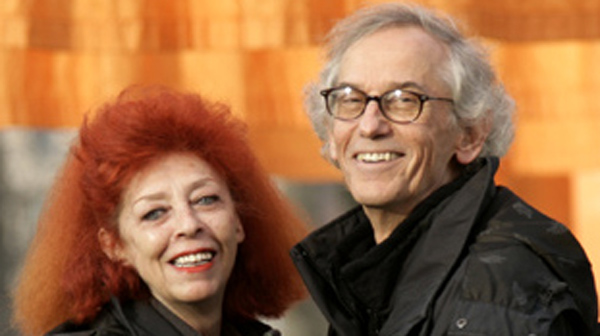 July 5, 2011 • 1:47:47Christo and Jeanne-Claude, artists To celebrate the opening of the exhibition Christo and Jeanne-Claude in the Vogel Collection on February 3, 2002, at the National Gallery of Art, artists Christo and Jeanne-Claude discussed their realized and non-realized projects. Featuring 72 works representing four decades of the artists' careers, the exhibition included preparatory drawings, collages, scale models for proposed large-scale works, and photographs of completed projects. In this podcast, the artists share their thoughts on The Gates, Project for Central Park, New York City; Wrapped Reichstag, Berlin; and Valley Curtain, Grand Hogback, Rifle, Colorado.
 July 26, 2011 • 1:14:53Jim Dine, artist, in conversation with Ruth Fine, curator of special projects in modern art, National Gallery of Art. Shortly after the opening of the exhibition Graphicstudio: Contemporary Art from the Collaborative Workshop at the University of South Florida, Jim Dine discussed his works in the Graphicstudio archive at the National Gallery of Art with Ruth Fine on September 29, 1991. On view from September 15, 1991, to January 5, 1992, the exhibition featured 140 works by 24 artists, including two sculptures given by Dine from his own collection to complete the archive formed in 1986. Instead of looking back on his well-documented career, the conversation also focused on his recent work in printmaking and on a drawings series completed in the dead of night at a European museum.
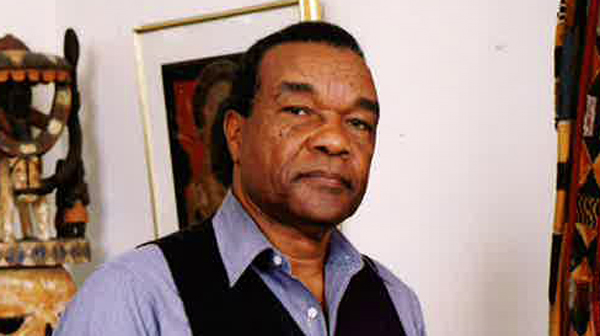 February 7, 2012 • 1:00:32David C. Driskell, professor emeritus, University of Maryland at College Park; Ruth Fine, curator of special projects in modern art, National Gallery of Art; and Julie L. McGee, Rockefeller Humanities Fellow, Center for Folklife and Cultural Heritage, Smithsonian Institution and author ofDavid C. Driskell: Artist and Scholar. To celebrate the publication ofDavid C. Driskell: Artist and Scholar, Ruth Fine and Julie L. McGee discuss the first biography and comprehensive monograph of his work with David C. Driskell. In this podcast recorded on April 14, 2007, at the National Gallery of Art, the participants share the collaborative process behind writing the book, which traces Driskell's personal, artistic, and scholarly journey. A pioneer in establishing the study of African American art within the canon of American art criticism and theory, Driskell is also an artist whose work approaches questions of nature and culture, African and African American heritage, spirituality, family, and other subjects.
 February 21, 2012 • 54:24David C. Driskell, artist, collector, and emeritus professor of art history, University of Maryland at College Park; in conversation with Ruth Fine, consulting curator of special projects in modern art, National Gallery of Art. FollowingThe Art of Romare Bearden, on view at the National Gallery of Art from September 14, 2003, through January 4, 2004, exhibition curator Ruth Fine joined lenders David C. Driskell and Frank Stewart to discuss another collaboration- their visual biography of the artist. Bearden (1911-1988) worked closely with Stewart from 1975 until his death and allowed Stewart to photograph him in his studio, at art-related events, and during his personal time. The resulting book, Romare Bearden, contains introductory texts by Driskell and Fine as well as an interview Fine conducted with Stewart that serves as running commentary alongside the book's images. In thisConversations with Artistsprogram recorded on December 11, 2004, the collaborators discuss their relationship with Bearden, the Gallery's Bearden exhibition, and the newly published visual biography.
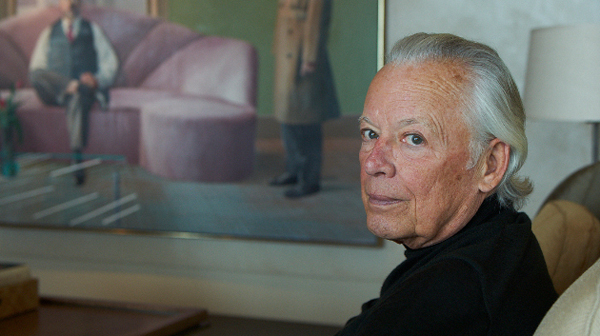 August 27, 2013 • 1:04:31Barney A. Ebsworth, collector, in conversation with Franklin Kelly, curator of American and British paintings, National Gallery of Art. To celebrate the opening of Twentieth-Century American Art: The Ebsworth Collection at the National Gallery of Art on March 5, 2000, Barney A. Ebsworth discussed the collection’s history and the works selected for the exhibition with Franklin Kelly, the Gallery's curator of American and British paintings. On view through June 11, 2000, the exhibition featured 52 paintings, 12 sculptures, and 10 works on paper belonging to Mr. and Mrs. Ebsworth. Included were works by Edward Hopper, Charles Sheeler, Georgia O'Keeffe, Andy Warhol, Arshile Gorky, and other American modernists. Ebsworth began collecting in the mid-1960s while living in Europe for military service and traveling for his cruise-ship business. Although his early acquisitions were 17th-century Dutch and Flemish and 18th-century Japanese art, eventually the exclusive focus of the collection became American modernist works dating from the Armory Show of 1913 onward. An important collection required having only the best works of a certain period, and Ebsworth felt that modern American art was more accessible in terms of scholarship, more affordable than older masterpieces, and connected to the life of our times. He reveals the friendships, joys and rewards that grew out of the collection.
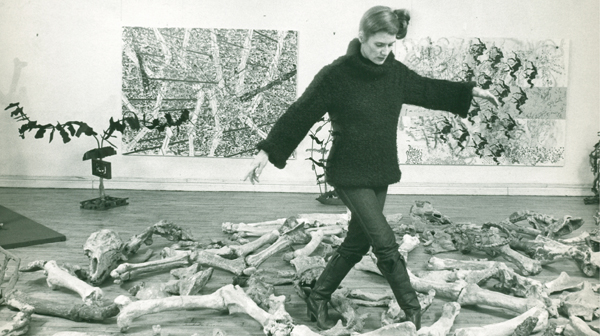 September 13, 2011 • 1:08:56Nancy Graves and Donald Saff, artists, in conversation with Ruth Fine, curator of special projects in modern art, National Gallery of Art. Artists Nancy Graves and Donald Saff, artist and founding director of Graphicstudio, discuss the formation of the Graphicstudio archive at the National Gallery of Art with Ruth Fine in this podcast recorded on October 6, 1991. This program was held in honor of the exhibition Graphicstudio: Contemporary Art from the Collaborative Workshop at the University of South Florida, which was on view from September 15, 1991, to January 5, 1992, and for which Graves completed her most recent work, Canoptic Legerdemain. The archive consists of 140 paintings, photographs, sculptures, and works in other media created by 24 artists who worked in collaboration with Graphicstudio's printers and artisans.
 July 23, 2013 • 52:54Margaret and Raymond Horowitz, collectors, in conversation with Nicolai Cikovsky Jr., senior curator of American and British paintings, National Gallery of Art, and Franklin Kelly, curator of American and British paintings, National Gallery of Art. In honor of the exhibitionAmerican Impressionism and Realism: The Margaret and Raymond Horowitz Collection, on view at the National Gallery of Art from January 24 to May 9, 1999, the Horowitzes joined Nicolai Cikovsky and Franklin Kelly to discuss the history of their collection and its first exhibition since a 1973 show at the Metropolitan Museum of Art. Forty-nine American impressionist and realist paintings and works on paper were presented, including works by William Merritt Chase, Childe Hassam, George Bellows, Maurice Prendergast, and William Glackens. In this conversation recorded on January 24, 1999, the Horowitzes share how their collection started with a few modest gifts, grew with the informal acquisition of drawings and pastels, and became a serious endeavor after their first painting purchase in 1961, a work by Robert Henri. From then on, the Horowitzes have exclusively collected American art. Making the most of their limited resources, the Horowitzes did not want to collect what was fashionable and turned to the work of American artists, which they thought was an overlooked treasure.
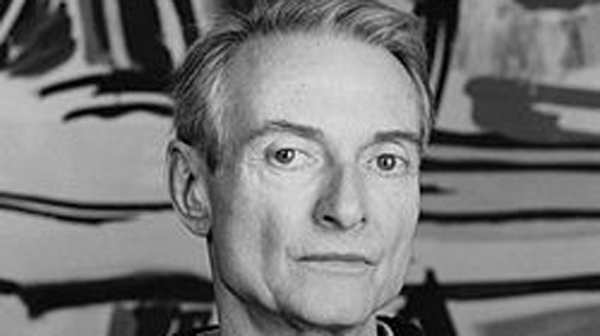 July 19, 2011 • 1:13:04Roy Lichtenstein, artist, in conversation with Jack Cowart, curator of 20th-century art, National Gallery of Art; introduction by Ruth Fine, curator of the department of graphic arts, National Gallery of Art. American artist Roy Lichtenstein appears in conversation with curator Jack Cowart to celebrate the exhibition Gemini G.E.L.: Art and Collaboration, on view at the National Gallery of Art from November 18, 1984, to February 24, 1985. In this recording from January 27, 1985, Lichtenstein discusses some of his 134 prints in the Gemini G.E.L. collection. Gemini G.E.L. (Graphic Edition Limited) is an artists' workshop and publisher of hand-printed limited-edition lithographs. Gemini G.E.L. played a pivotal role in the formation of the Gallery's contemporary collection when Sidney B. Felsen and Stanley Grinstein, owners of Gemini, donated 256 prints and sculpture editions by 22 contemporary American artists working at Gemini G.E.L. of Los Angeles. The archive collection now has more than 1,200 works, establishing the Gallery as a primary research center in the field of contemporary graphic art and edition sculpture.
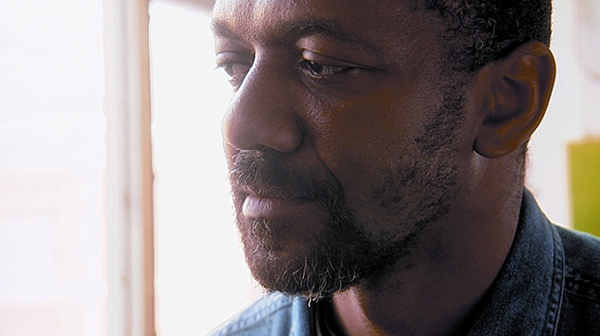 July 2, 2013 • 1:12:20Kerry James Marshall in conversation with James Meyer, associate curator of modern art, National Gallery of Art. Kerry James Marshall has exhibited widely in both the United States and abroad and is the recipient of a MacArthur Fellowship, among other honors. His work often explores the experiences of African Americans and narratives of American history that have historically excluded black people. Drawing upon the artist’s prodigious knowledge of art history and African diasporic culture, his paintings combine figurative and abstract styles and multiple allusions. In Marshall’s art, the past is never truly past: history exerts a constant, often unconscious pressure on the living. In this program recorded on June 26, 2013, Marshall discusses the works and themes of his exhibitionIn the Tower: Kerry James Marshall, on view at the Gallery fromJune 28 to December 7, 2013.
 March 5, 2013 • 40:04Robert and Jane Meyerhoff, collectors, in conversation with Irving Blum, collector and co-founder of the Ferus Gallery, Los Angeles. To celebrate the exhibition opening of The Robert and Jane Meyerhoff Collection: 1945-1995 at the National Gallery of Art on March 31, 1996, the Meyerhoffs joined Irving Blum to discuss the history and practice of their collecting. On view through July 21, 1996, the exhibition presented 194 works, almost their entire collection of post-World War II art. The Meyerhoffs' acquisitions have been based wholly on their belief in the quality of individual works and not on any preconceived theory or plan. If they were passionate about an artist, they collected his or her work in depth. Their private residence has a room dedicated to each of the following artists: Jasper Johns, Ellsworth Kelly, Roy Lichtenstein, Robert Rauschenberg, and Frank Stella. The collection is both a tribute to the extraordinarily high level of accomplishment by these artists and to the Meyerhoffs' intuition.
 August 16, 2011 • 1:06:09Richard Misrach, photographer To coincide with the exhibition Carleton Watkins: The Art of Perception, on view from February 20 to May 7, 2000, Richard Misrach discussed his photographs of desert cantos and other landscapes as following in Watkins' legacy. The lecture took place on March 26, 2000. Misrach distinguished himself in his 30-year career as one of the most accomplished photographers of our time. His passionate and intelligent records of the American West present the chilling details of assaults on the landscape by contemporary civilization, while also eloquently revealing its enduring beauty. Misrach explains that although he was not conscious of Watkins' photographs, which evidence the man-made in Pacific Northwest landscapes and were taken more than a hundred years ago, the profound influence of his work is unmistakable.
 July 12, 2011 • 1:21:53Claes Oldenburg and Coosje van Bruggen, artists, in conversation with Germano Celant, senior curator of contemporary art, Solomon R. Guggenheim Museum; introduction by Marla Prather, associate curator of 20th-century art, National Gallery of Art. Claes Oldenberg (born 1929) and Coosje van Bruggen (1942-2009) transform familiar objects through their sculptures and give them a new reality filled with mystery, humor, and sensuality. Gemano Celant, organizing curator of the travelling exhibition Claes Oldenburg: An Anthology, on view at the Gallery from February 12 to May 7, 1995, joins the artists in this lecture. In this recording from March 5, 1995, the trio discuss the art in the exhibition—the first survey of their art since 1969—and how it offers a sense of interaction unlike anything else in a museum.
 August 9, 2011 • 39:10Ed Ruscha, artist. Ed Ruscha discusses his artistic processes and influences, and their relationship to photography, drawing, and pop culture in this podcast recorded on February 13, 2005, at the National Gallery of Art. This lecture marked the opening of Cotton Puffs, Q-Tips®, Smoke and Mirrors: The Drawings of Ed Ruscha, the first museum retrospective of the artist's drawings. The title of the exhibition refers to a quote from Ruscha about some of his drawing tools (cotton puffs and Q-tips®) and illusionary effects (smoke and mirrors). Featuring 89 works and 6 studio notebooks dated from 1959 to 2002, the retrospective traces Ruscha's career from early pop images of American commercial logos and gas stations to later images depicting words and phrases as subject matter.
 March 13, 2012 • 52:21Joel Shapiro, artist. Following the installation of Joel Shapiro'sUntitled(1989) in the National Gallery of Art Sculpture Garden with other major post-World War II sculptures, the artist received an invitation to curate an exhibition of his work alongside the 19th-century sculpture of Jean-Baptiste Carpeaux. In this podcast recorded on March 9, 2003, Shapiro explains that the upcoming exhibition gave him on opportunity to focus on the continuity of thought in sculpture. Although certain ideas for form in sculpture seem radical and contemporary, their ideas have already been discovered and worked with in earlier times. Shapiro finds that the development of form seems to repeat itself, although it is ever-changing, more or less focused, and contextualized by the era in which it was created.
 August 2, 2011 • 1:14:34Pat Steir, artist, and Kathan Brown, founder and director of Crown Point Press, in conversation with Ruth Fine, curator of special projects in modern art, National Gallery of Art. In this podcast recorded on March 25, 1990, at the National Gallery of Art, Pat Steir appears in conversation with Kathan Brown to celebrate the exhibition The 1980s: Prints from the Collection of Joshua P. Smith. Moderated by exhibition curator Ruth Fine, the conversation explores the role that printmaking and the artist's involvement with Crown Point Press have played in her career. Also examined is Steir's use of paintings and drawings to address many of the important visual and conceptual issues of her generation.
 February 21, 2012 • 58:27Lou Stovall, artist, in conversation with Ruth Fine, curator of special projects in modern art, National Gallery of Art. As part of the National Gallery of Art summer lecture seriesFive African American Artists: Johnson-Tanner-Johnson-Stovall-Thomas, Lou Stovall participated in aConversations with Artistsprogram with Ruth Fine on August 3, 2003. "Compositions and Collaborations: The Arts of Lou Stovall" is a rare opportunity to hear Stovall discuss his own work and his collaborations with other artists, and to listen as he responds to questions from the audience. Stovall has been a major figure in the Washington, DC, arts community since the early 1960s, when he arrived at Howard University for his BFA program. In 1968 Stovall founded Workshop, Inc., a professional printmaking studio, where he has collaborated with more than 70 artists over the years. In addition to his own drawings and silkprints, and his collaborative printmaking projects, Stovall is a published essayist and poet.
 April 19, 2011 • 57:38Wayne Thiebaud, artist, in conversation with Kathan Brown, president, Crown Point Press, and Ruth Fine, curator of modern prints and drawings, National Gallery of Art. In this podcast recorded on June 8, 1997, to celebrate the opening of the Gallery's Thirty-Five Years at Crown Point Press exhibition, artist Wayne Thiebaud discusses his career with Kathan Brown, president of Crown Point Press, and curator Ruth Fine of the National Gallery of Art. The conversation focuses on Theibaud's prints, which feature themes that also appear in his paintings and drawings. These works depict a wide variety of sumptuous foodstuffs as well as the colorful California landscape.
 September 14, 2010 • 1:01:20Leo Villareal, artist, in conversation with Molly Donovan, associate curator of modern and contemporary art, National Gallery of Art. In this podcast recorded on September 7, 2008, at the National Gallery of Art, American artist Leo Villareal and curator Molly Donovan discuss Villareal's Multiverse installation, which occupies the Concourse walkway between the East and West Buildings of the National Gallery of Art. Installed between September and December of 2008, Multiverse is one of the largest and most complex light sculptures created by the artist, featuring approximately 41,000 computer-programmed LED (light-emitting diode) nodes that run through channels along the 200-foot-long space.
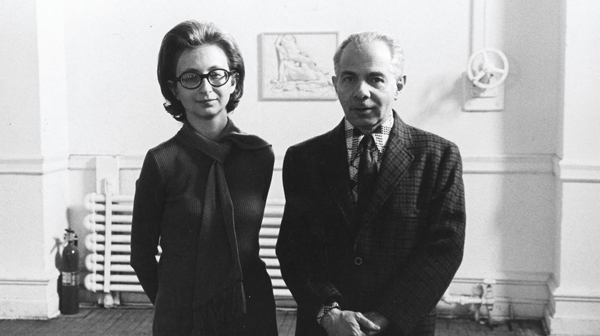 May 14, 2013 • 57:41Dorothy and Herbert Vogel, collectors, in conversation with Ruth Fine, curator of modern prints and drawings, National Gallery of Art; and Mark Rosenthal, curator of twentieth-century art, National Gallery of Art. New York collectors Herbert and Dorothy Vogel trace the development of their vast art collection in this podcast recorded on June 12, 1994 at the National Gallery of Art in honor of the exhibition From Minimal to Conceptual: Works from The Dorothy and Herbert Vogel Collection. The Vogels began collecting art in the 1960s, a time that saw a new generation of artists respond to the abstract expressionist movement. These artists questioned the entire practice of art making, the nature of the art object, and how art functioned within society. By forming close personal relationships with the artists, a process that the Vogels describe as invaluable, they assembled one of the country's greatest and most extensive collections of conceptual, minimal, and post-minimal art with limited financial means. From Minimal to Conceptual was the first major showing of their collection at the National Gallery of Art and was on view from May 29 through November 27, 1994.
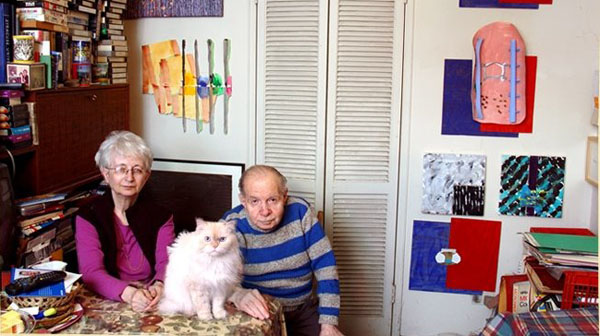 September 21, 2010 • 54:26Dorothy and Herbert Vogel, collectors, in conversation with Ruth Fine, curator of special projects in modern art, National Gallery of Art. New York art collectors Dorothy and Herbert Vogel discuss the genesis of their extraordinary art collection with curator Ruth Fine in this podcast recorded on Sunday, November 16, 2008, at the National Gallery of Art. Over a 45-year period, the Vogels collected 4,782 works of art and stored them in their one-bedroom New York apartment. In 1991, the National Gallery of Art acquired a portion of their collection, through partial purchase and gift from the Vogels, which consists largely of minimal and conceptual art. In 2008, the Vogels and the National Gallery of Art, with assistance from the National Endowment for the Arts and the Institute of Museum and Library Services, launched a national gifts program titled The Dorothy and Herbert Vogel Collection: Fifty Works for Fifty States in 2008. The program distributed 2,500 works from the Vogels' collection throughout the nation, with 50 works going to a selected art institution in each of the 50 states.
 July 20, 2010 • 1:10:33Mel Bochner, artist, in conversation with Jeffrey Weiss, curator and head of the department of modern and contemporary art, National Gallery of Art. Mel Bochner is one of the most prominent figures of the minimal and conceptual art generation. In this podcast recorded on March 11, 2007, at the National Gallery of Art, he discusses his body of work, which spans 40 years and includes painting, drawing, sculpture, photography, film, and installation, with Gallery curator Jeffrey Weiss. This podcast honors the Gallery's acquisition of Bochner's painting Theory of Boundaries (1969-1970).
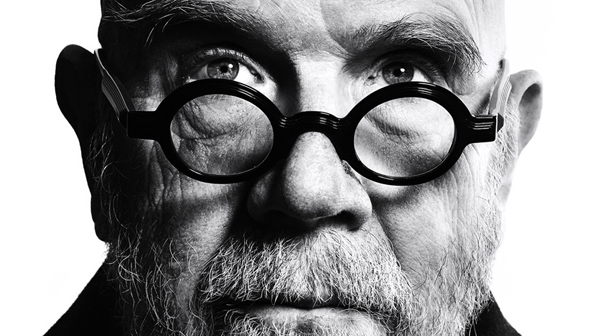 July 20, 2010 • 1:20:44Chuck Close, artist, in conversation with Jeffrey Weiss, curator of 20th-century art, National Gallery of Art. This podcast recorded on October 17, 1999, was the first program in the Diamonstein-Spielvogel Lecture Series at the National Gallery of Art. The series began on a high note with artist Chuck Close, one of the preeminent painters of his generation, who discussed his work and career with Gallery curator Jeffrey Weiss.
 February 8, 2011 • 1:15:23Andy Goldsworthy, artist. Held in conjunction with the exhibitions The Andy Goldsworthy Project and Andy Goldsworthy: Roof, Andy Goldsworthy spoke about his career and current projects in this podcast recorded on January 23, 2005, at the National Gallery of Art. Goldsworthy has gained worldwide renown for works both ephemeral and permanent that draw out the endemic character of a place. The artist employs natural materials such as leaves, sand, ice, and stone that often originate from the site of the project. Roof, a site-specific sculpture, consists of nine hollow, low-profile domes of stacked slate, each with a centered oculus, that run the length of the ground-level garden area on the north side of the Gallery's East Building. Goldsworthy selected the dome form as a counterpoint to the many architectural domes in Washington, DC. The Andy Goldsworthy Project catalogue is available for purchase in the Gallery Shop.
 September 20, 2011 • 1:08:44Ann Hamilton, artist. On September 16, 2011, Ann Hamilton presented a lecture on her nearly 30-year career as part of the Diamonstein-Spielvogel Lecture Series at the National Gallery of Art. Hamilton has made multimedia installations with stunning qualities and quantities of materials: a room lined with small canvas dummies, a table spread with human and animal teeth, the artist herself wearing a man's suit covered in a layer of thousands of toothpicks. Along the way, she has constantly set and reset the course of contemporary art. Often using sound, found objects, and the spoken and written word, as well as photography and video, her objects and environments invite us to embark on sensory and metaphorical explorations of time, language, and memory. Textiles and fabric have consistently played an important role in her performances and installations—whether she is considering clothing as a membrane or (more recently) treating architecture itself as a kind of skin. The Gallery owns fifteen works by the artist, including photographs, prints, sculptures, and a video installation.
 August 22, 2016 • 1:22:49Jenny Holzer in conversation with Harry Cooper, curator and head of modern and contemporary art, National Gallery of Art, Washington. Jenny Holzer discusses her powerful text-based work with curator Harry Cooper in this podcast recorded on May 6, 2011, as part of the Diamonstein-Spielvogel Lecture Series at the National Gallery of Art. Having enlivened public spaces all over the world for nearly 35 years, Holzer is best known for her LED (light-emitting diode) signs. In 1990, she was the first woman to have a solo presentation in the U.S. Pavilion at the Venice Biennale, for which she was awarded the Golden Lion. Since 2004, she has mined declassified documents for her series Redaction Paintings, of which she donated six to the Gallery In 2010. Holzer lives and works in New York.
 May 4, 2010 • 1:15:56Brice Marden, artist, in conversation with Harry Cooper, curator and head of modern and contemporary art, National Gallery of Art, Washington. As part of the Diamonstein-Spielvogel Lecture Series at the National Gallery of Art, artist Brice Marden joined Harry Cooper, the Gallery's curator and head of the department of modern and contemporary art, to discuss the evolution of his career and the influence of his contemporaries on his work. In this podcast, recorded on November 22, 2009, Marden and Cooper also discuss five paintings and two drawings by Marden in the Robert and Jane Meyerhoff Collection, promised gifts to the National Gallery.
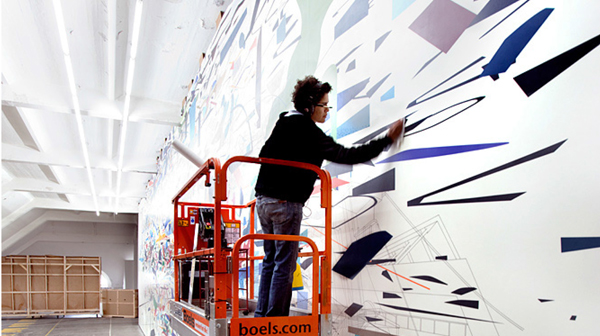 November 26, 2013 • 53:30Julie Mehretu, artist, in conversation with Judith Brodie, curator and head, department of modern prints and drawings, National Gallery of Art. Julie Mehretu is best known for large-scale, densely packed paintings that combine meticulous rendering and seemingly spontaneous abstract gesture. Her work, including drawings and prints, is built up from multiple layers of archival, geographical, meteorological, and architectural imagery—designs, plans, diagrams, blueprints, ruins, charts, and graphs—traced and punctuated with calligraphic marks and obscuring erasures. She maps the histories of civilizations past and present, engaging with issues of social organization, globalization, and geopolitical connectivity. Mehretu has completed collaborative projects at professional printmaking studios across the United States, among them Gemini G.E.L in Los Angeles and Crown Point Press in San Francisco. For the Diamonstein-Spielvogel Lecture Series at the National Gallery of Art, Mehretu joined Judith Brodie on November 17, 2013 to discuss her career and artistic process, which can be seen firsthand in two prints: Circulation, in the Gallery’s collection, and Circulation (working proof 9), on view through January 5, 2014 in the exhibition Yes, No, Maybe: Artists Working at Crown Point Press.
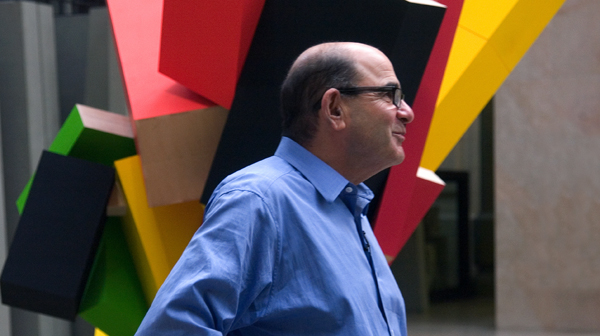 November 6, 2012 • 43:41Joel Shapiro, artist. On October 28, 2012 at the National Gallery of Art, Joel Shapiro presents a lecture on his nearly 50-year career as part of the Diamonstein-Spielvogel Lecture Series. Born in 1941 in New York City, Shapiro received BA and MA degrees from New York University. Since his first exhibition in 1970, Shapiro has become one of the most widely exhibited American sculptors and the subject of many solo exhibitions and retrospectives, and his work can now be found in numerous public collections in the United States and abroad. His work, from early minimal objects to increasingly expansive and complex forms, has always dealt with such central issues of the sculptural tradition as size and scale, balance and imbalance, figuration and abstraction. He believes that all sculpture is a projection of thought into the world, and he strives to create intimacy and vitality in all his projects. Shapiro lives and works in New York City. The Gallery owns 16 works by the artist, including drawings, prints, and sculptures.
 July 20, 2010 • 1:12:21Rachel Whiteread, artist, in conversation with Molly Donovan, associate curator of modern and contemporary art, National Gallery of Art. British sculptor Rachel Whiteread has enjoyed international acclaim for her provocative sculptural practices. Beginning in the early 1990s with positive casts of empty architectural spaces and household objects, Whiteread has continued to articulate typically unseen, immaterial space in increasingly public settings. Her breakthrough work, Ghost (1990), was given to the National Gallery of Art in 2004 by the Glenstone Foundation. In this podcast recorded on October 12, 2008, at the National Gallery of Art, Rachel Whiteread and Gallery curator Molly Donovan discuss all aspects of Whiteread's career, with a particular focus on Ghost.